Introduction
Long-distance transportation of high-solids sludge remains a major technical challenge in textile printing-dyeing, mining and municipal wastewater treatment projects. As a typical non-Newtonian fluid, high-concentration sludge contains abundant solid particles and generates far higher pipeline friction than clean water. When conventional centrifugal pumps are applied under such working conditions, operators frequently encounter rapid impeller wear, pipeline blockages, flow decay and frequent maintenance shutdowns, which negatively affect stable operation of sludge-disposal facilities.
To address real-world demands for kilometer-scale high-solids sludge transfer, Sinou Environmental’s technical team has completed a special feasibility study. Taking 40% solid-content dewatered sludge as the medium, the study covers hydraulic calculation, hydraulic system matching verification, complete-set configuration selection, risk assessment and economic evaluation. The analysis provides valuable reference for EPC contractors, design institutes and end-users on equipment selection for sludge-transport projects.
Core Calculation Conditions
The boundary conditions defined for this assessment are as follows:
According to hydraulic calculation, the density of sludge reaches 1360 kg/m³. DN150 wear-resistant pipe is adopted with flow velocity at 1.57 m/s. Combining 20 m static head and friction loss ranging from 40 m to 70 m (55 m taken for intermediate estimation), the total slurry column head arrives at 75 m. The theoretical required outlet pressure of the pump is around 1.0 MPa. Considering local resistance and safety allowance, the rated working pressure of the pump should be no less than 1.2 MPa.
A 1:10 area ratio between hydraulic cylinder and slurry cylinder is adopted for hydraulic matching. Verification shows that the rated pressure of HY180 pump is 31.5 MPa, well above the required working oil pressure of 12 MPa. Its output flow can satisfy system requirements. Equipped with a 40-45 kW VFD motor, flow can be adjusted by variable-frequency speed control to avoid unnecessary power waste. Theoretical calculation proves this power configuration can meet project design targets.
Recommended Complete-Set Configuration
To guarantee long-term stable operation, the technical department proposes the following full-scope configuration:
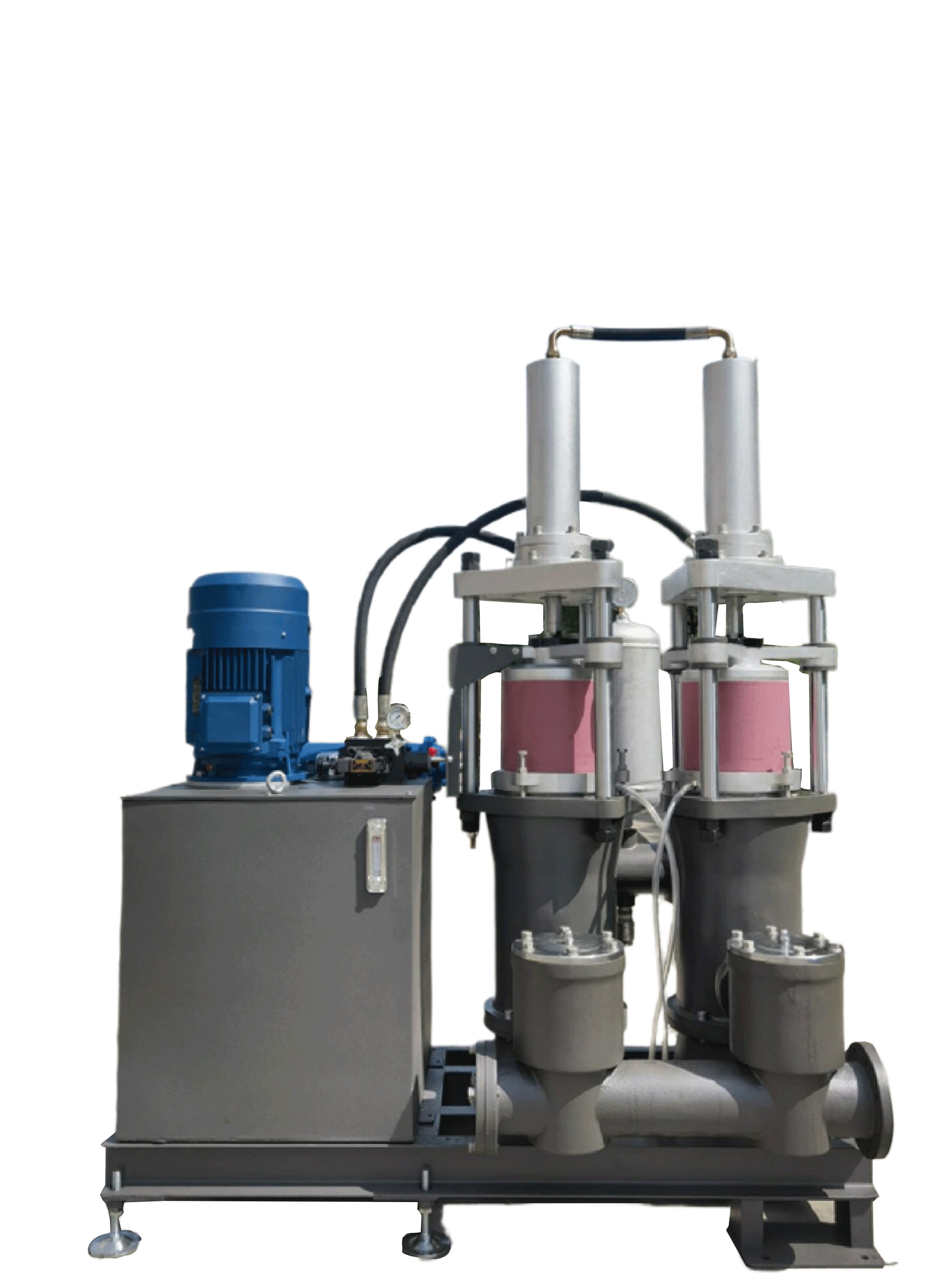
1.Hydraulic ceramic plunger pump main unit
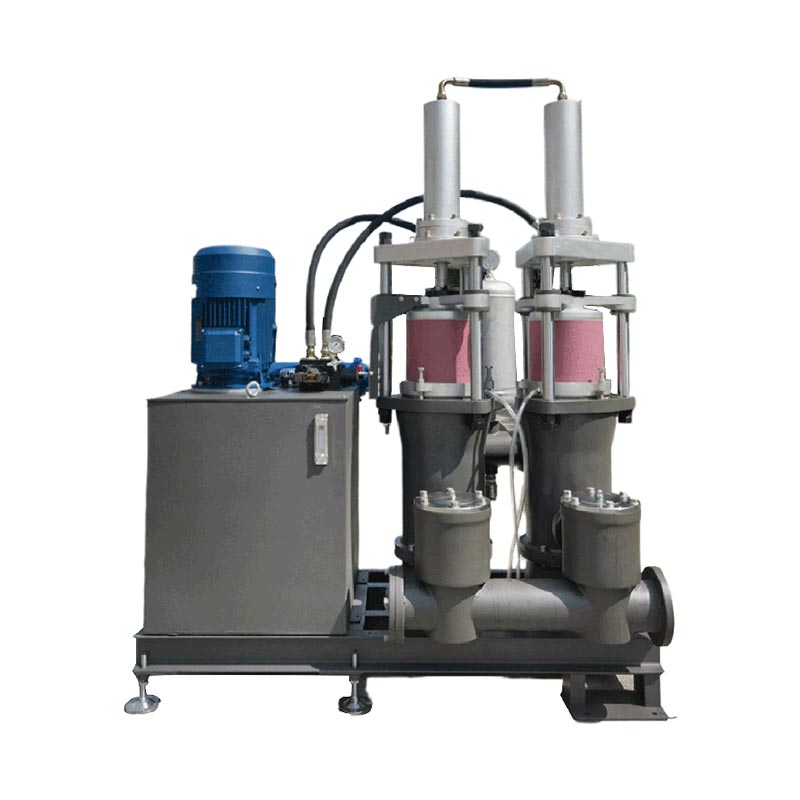
Adopt double-cylinder or triple-cylinder structure with ceramic plungers and ceramic valve seats. Rated flow is 105-110 m³/h with operational margin; rated pressure ≥1.6 MPa. The area ratio of hydraulic cylinder to slurry cylinder is designed as 1:10. Ceramic components deliver outstanding anti-abrasion performance against continuous scouring of high-solids sludge and extend service interval of wearing parts.
2.Hydraulic power station
Deploy HY180 axial piston variable pump for flexible on-site pressure and flow adjustment. A 45 kW VFD motor with IP55 protection class and F-class insulation is selected. Supporting components include standard oil tank, cooling unit, filtration system and integrated valve blocks. The combination of variable pump and VFD motor dynamically adjusts output according to sludge conditions to realize energy-saving performance.
3.Pipeline system
DN150 PN16 wear-resistant pipeline is recommended. Material options include UHMW-PE or steel-lined plastic. The actual laying length should reserve margin up to 1050 m to compensate local resistance caused by elbows and connections.
4.Automatic control system
PLC-based control system collects real-time data including pump outlet pressure, flow rate, hydraulic-station oil pressure and oil temperature. Both constant-flow and constant-pressure control modes are supported. Built-in protections against over-pressure, over-temperature and overload trigger alarms upon faults and lower on-site operation risks.
Project Risks & Mitigation Measures
Pipeline friction loss in this study is estimated based on empirical coefficients. Actual field resistance varies significantly due to sludge rheology, particle composition, temperature and pipe inner-surface condition, ranging from 40 m to 70 m or even higher under extreme circumstances.
If on-site friction loss exceeds estimated values, required pump pressure and hydraulic oil pressure will rise. Insufficient margin will shorten equipment service life. Three practical countermeasures are proposed:
Economic & Reliability Evaluation
The HY180 axial piston pump is a mature and standardized hydraulic component with stable supply chain and controllable initial investment for the whole hydraulic station. The single-pump layout features simple structure and fewer failure points for convenient field maintenance. Ceramic plungers and valve seats provide superior wear-resistance for high-solids sludge service, reducing spare-parts consumption and downtime.
Assuming annual operating hours of 6000 h and industrial electricity price of 0.7 CNY/kWh, the annual power consumption cost for the 45 kW motor is approximately 189 000 CNY. It delivers favorable energy efficiency and fits continuous sludge-transport scenarios such as textile wastewater treatment, mine tailings disposal and municipal sludge projects.
Conclusion
Based on comprehensive calculation and assessment, driven by HY180 axial piston variable pump and 45 kW VFD motor, the hydraulic ceramic plunger pump can technically realize 100 m³/h transportation of 40% solid-content sludge over 1000-meter horizontal distance under proper system design.
It should be emphasized that measured sludge rheological data is essential for successful project delivery; empirical estimation alone cannot replace real sample testing. This report can serve as a reference for EPC contractors, design institutes and industrial enterprises during sludge-disposal-project equipment selection.
Reference Document: Feasibility Technical Analysis Report on Hydraulic Ceramic Plunger Pump for High-Concentration Sludge Conveying, Sinou Technical Department, Dec 29, 2025