• Experience

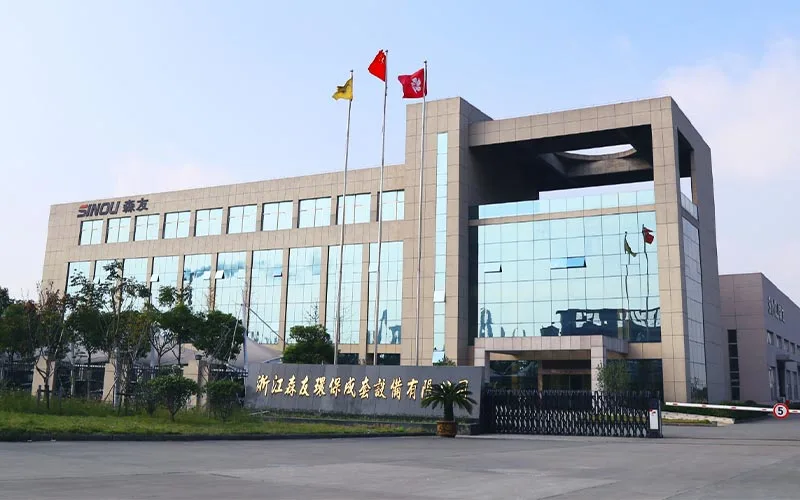
    With over 40 years of innovation since 1982, Sinou holds numerous national patents, including China’s first sand-gravel separator. Our proven track record ensures reliable, field-tested solutions for global concrete and wastewater treatment projects.

  • Customization

    We provide end-to-end tailored systems—from ceramic plunger pumps to zero-emission wastewater recycling. Every solution is engineered to match your specific working conditions, delivered with fast sampling, design validation, and professional commissioning.

  • Compliance

    CE and UL certified, plus ISO9001, ISO14001, and ISO45001. Recognized as a Zhejiang First-set Equipment Enterprise, our magnetic neutralization water treatment system meets strict international standards for safety, energy efficiency, and environmental protection.

  • Support

    One-stop service from pre-sales consultation to after-sales training and spare parts. Our responsive quality guarantee and global shipping via Shanghai/Ningbo ports ensure minimal downtime and maximum ROI for clients ranging from multinationals to local factories.

Product Category

As a direct China factory with over 15 years of expertise, Sinou delivers a full range of environmental protection equipment, all backed by strict quality control and CE, ISO certifications.
  • Piston Pump For Filter Press
    Piston Pump For Filter Press

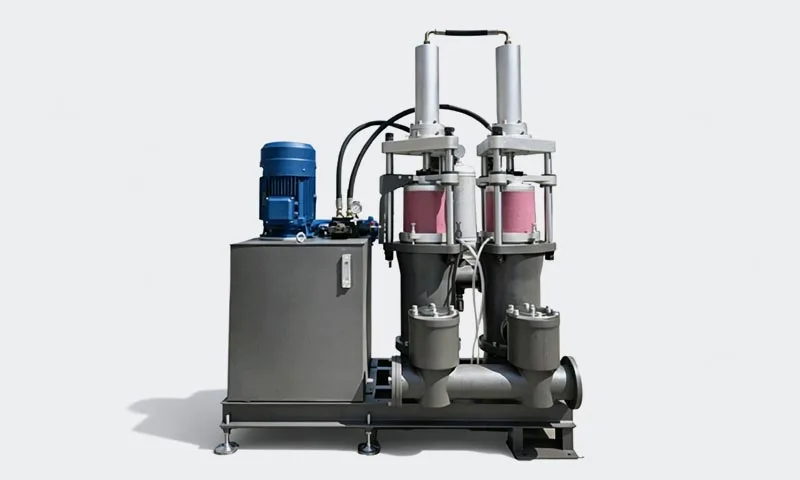
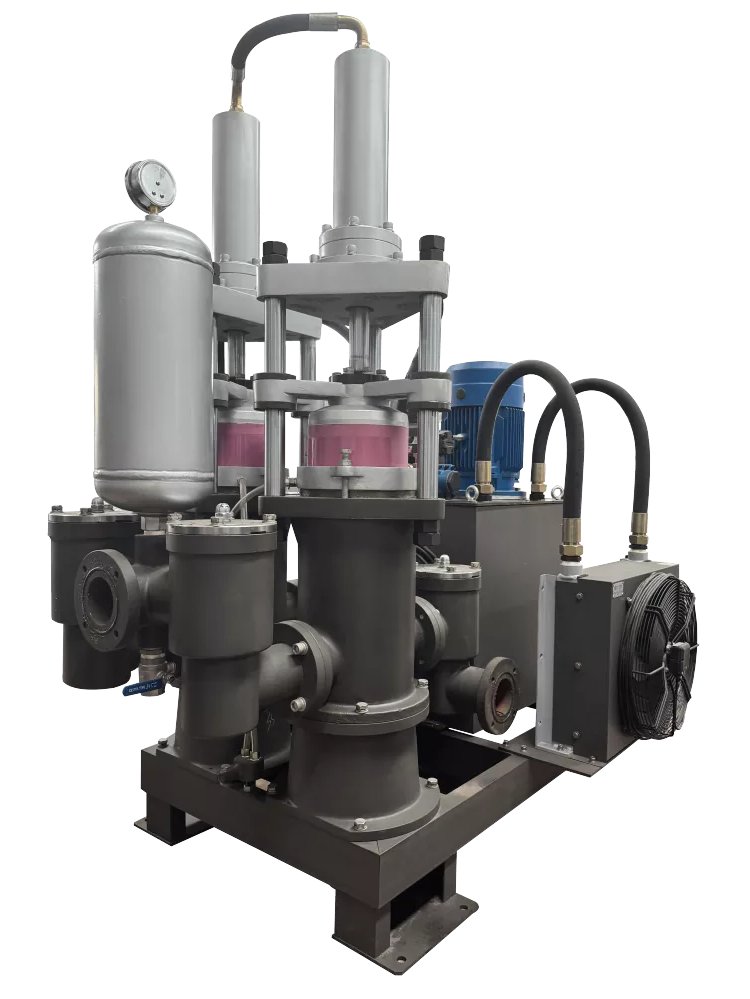
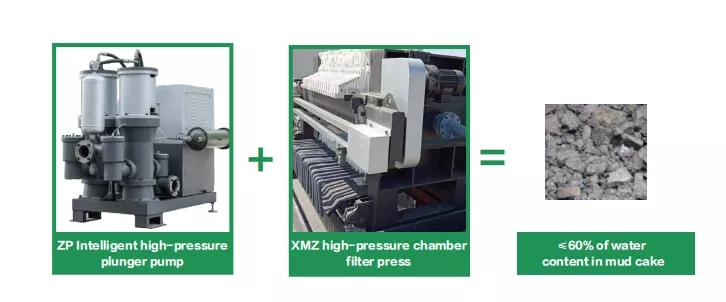
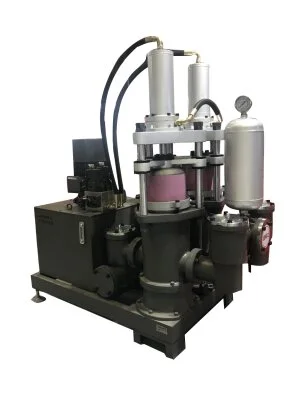
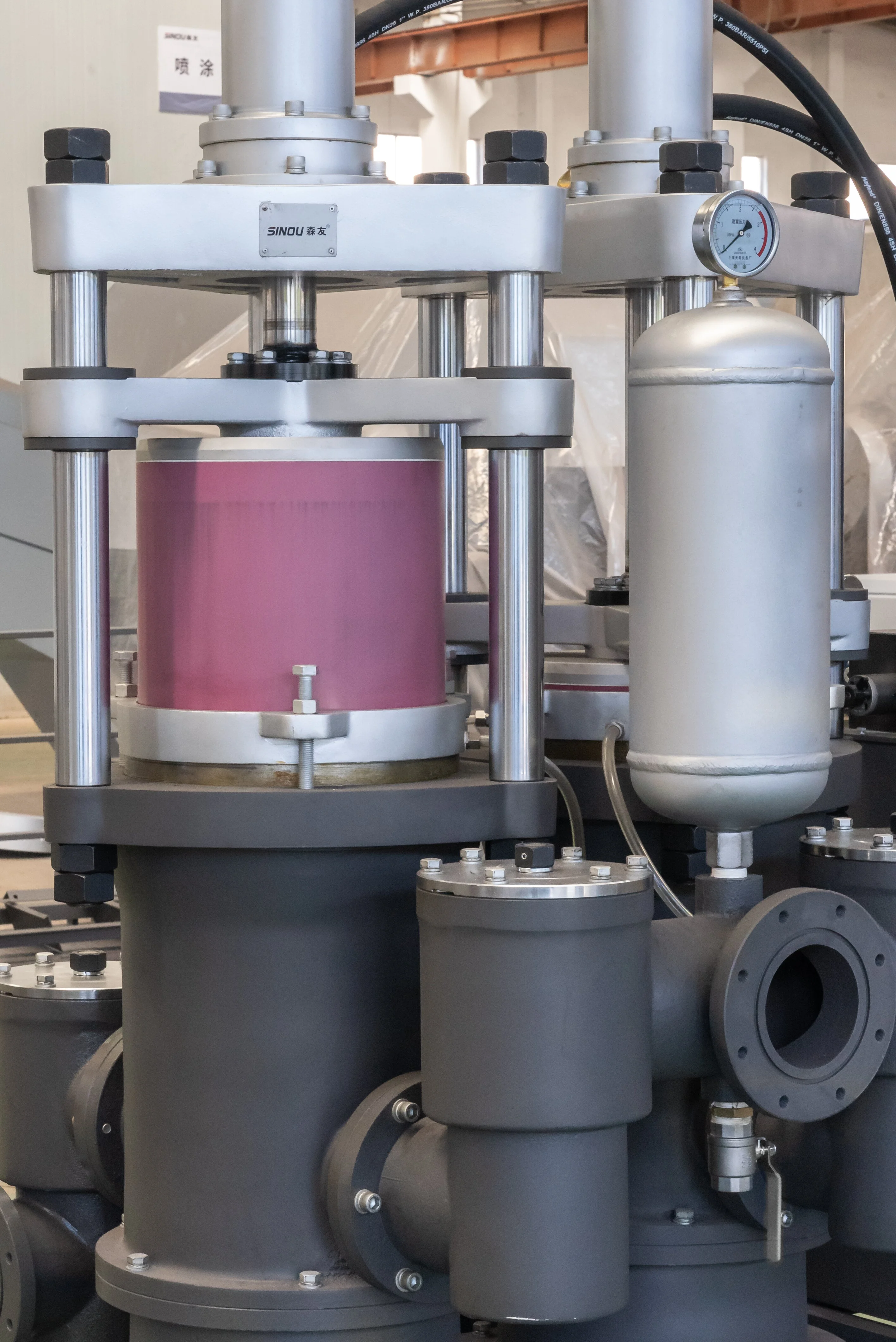
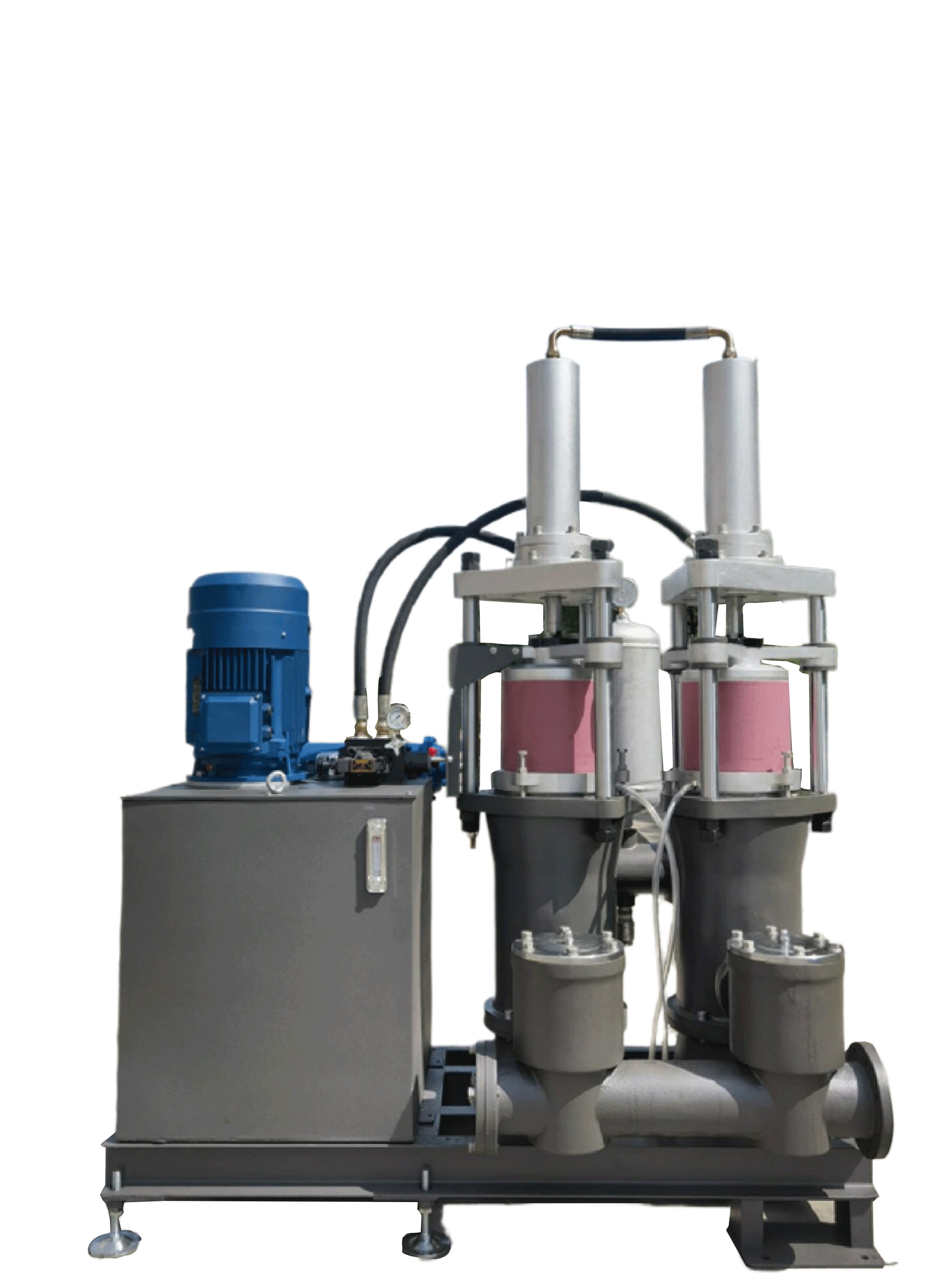
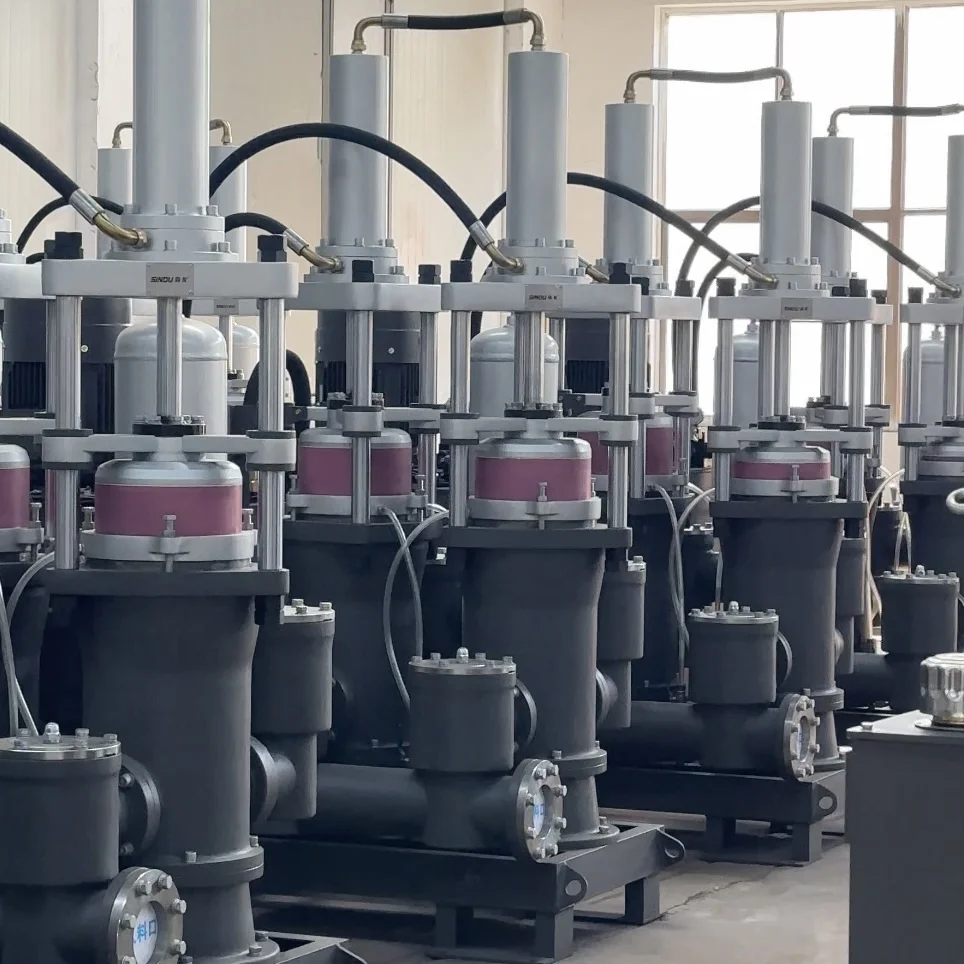
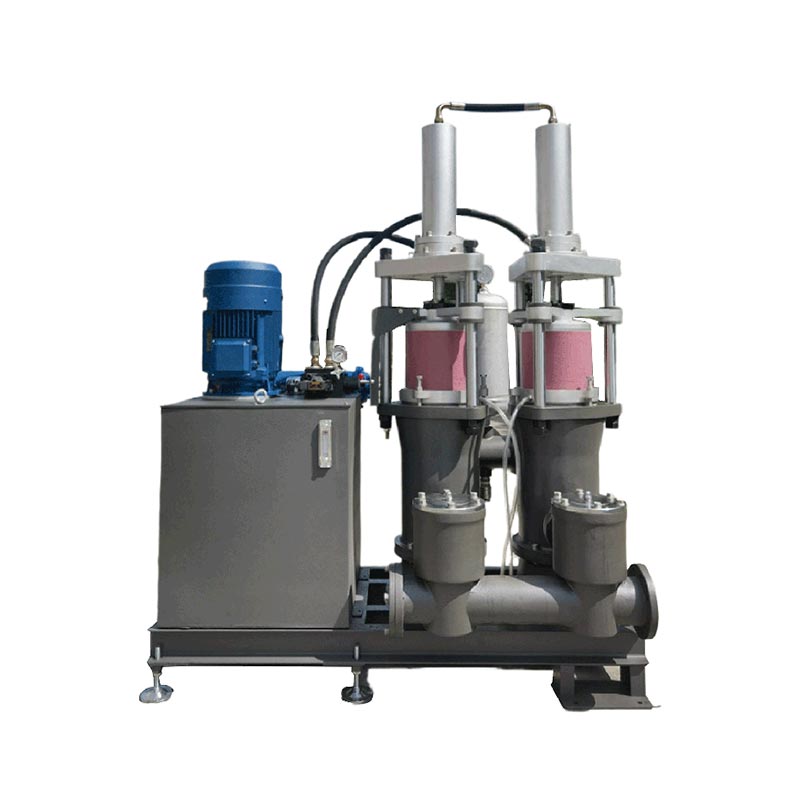
    SINOU is a professional manufacturer and global supplier of Piston Pump For Filter Press. This dedicated feeding pump is specially designed to match membrane filter press and chamber filter press for wastewater treatment, chemical and printing & dyeing industries.

    Piston Pump For Filter Press

    Basic Introduction & Core Definition

    1. Structural feature:

    Adopts hydraulic-driven reciprocating plunger structure, perfectly fits the two-stage working mode of filter press

    ● Low-pressure large flow: Realize rapid filling of filter chamber

    ● High-pressure small flow: Complete deep dewatering of sludge

    2. Core advantages over ordinary slurry pumps

    ● Stable pressure output, strong abrasion resistance and intelligent flow adjustment

    3. Application matching

    ● Works stably with Chemical Printing and Dyeing Membrane Filter Press and other sludge dewatering equipment

    ● Improves overall solid-liquid separation efficiency, compact structure and long service life, widely recognized by global users

    Piston Pump For Filter Press

    Working Principle & Structural Advantages

    As a reliable factory specializing in Piston Pump For Filter Press, we adopt positive displacement working principle to solve the feeding problem of viscous and particle-containing sludge for filter presses.

    1. Working principle

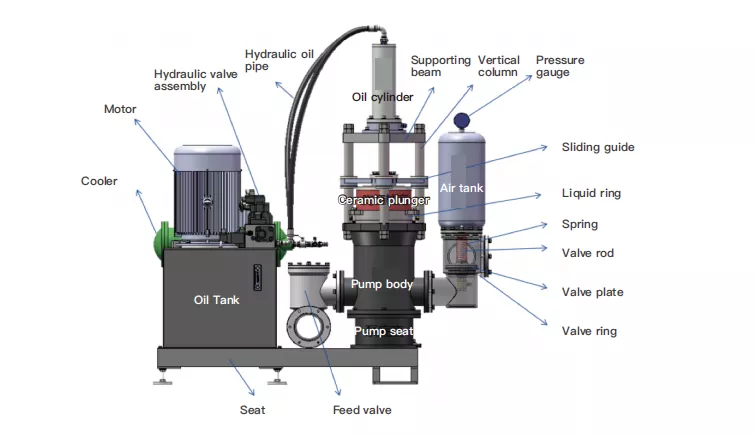
    ● Driven by integrated hydraulic system, the ceramic plunger performs continuous reciprocating movement

    ● Flow rate and working pressure adjust automatically according to internal resistance of filter press

    2. Key structural design highlights

    ● Ceramic plunger: 5-8 times higher wear resistance than common metal parts, resists scouring of sand-containing and corrosive slurry

    ● Imported composite sealing components: Effectively prevent slurry leakage

    3. Overall performance & matching accessories

    ● Higher operating efficiency and lower energy consumption than traditional centrifugal pumps

    ● Used together with Strength Carbon Steel Squeezing Sleeve to stabilize equipment connection and reduce failure rate

    Piston Pump For Filter Press

    Product Features & Performance Highlights

    1. Six core product advantages

    ● High pressure resistance: Max working pressure up to 2.5MPa

    ● Energy saving: Power saving rate over 80% compared with conventional feed pumps

    ● Strong anti-corrosion, stable operation, easy maintenance and wide adaptability

    2. Quality identification standard

    ● Qualified products keep pressure fluctuation within ±0.5Mpa, no filter plate dislocation or slurry leakage

    3. Material customization & supporting use

    ● Pump body optional with cast iron or 316 stainless steel for acid and alkali slurry

    ● Compatible with Rust Preventive Treated Threaded Sleeve, effectively cut daily maintenance cost of filter press system

    Wide Application Scenarios & Industry Matching

    SINOU provides high-quality Piston Pump For Filter Press applicable to multiple industrial solid-liquid separation fields, including municipal sewage, chemical, printing & dyeing, papermaking, electroplating, mining, food and pharmaceutical industries.

    1. Industry differentiated demands

    ● Municipal sewage: Require large flow and continuous operation capability

    ● Chemical & electroplating: Focus on anti-corrosion performance

    ● Mining & coal washing: Prioritize wear resistance

    2. FAQ

    Q: Is this piston pump applicable for conveying high-viscosity and high-solid-content slurry?

    A: Definitely yes. This is a positive displacement piston pump that operates based on volumetric displacement principle. Its conveying capacity is barely affected by medium viscosity, fluidity or solid particle content. It can stably deliver various complex media with solid content up to 40% and above, such as thick sludge, paste-like slurry and particle-laden mixed materials from wastewater, chemical, printing and dyeing industries. Compared with conventional centrifugal pumps, it effectively prevents flow fluctuation, pipeline blockage and inadequate feeding, and guarantees continuous, uniform material supply for filter presses under harsh working conditions.

    Q: What are the main differences between this piston pump and ordinary slurry pumps?

    A: This piston pump is professionally customized for filter press supporting use. It features dual-mode automatic switching of pressure and flow to match the filling and dewatering process of filter presses. It delivers more stable output pressure, superior wear resistance and lower energy consumption. Ordinary slurry pumps are mostly designed for single-flow conveying, unable to adapt to the high-pressure dewatering demand of filter presses, and prone to pressure loss and slurry leakage during long-term operation.

    Q: Can the pump automatically adjust pressure and flow during operation?

    A: Yes. Equipped with an intelligent sensing and regulating system, the pump can monitor the internal resistance of the filter press in real time. It realizes stepless automatic adjustment of flow rate and working pressure throughout the whole process, switching between low-pressure large flow for rapid cavity filling and high-pressure small flow for deep dewatering without manual intervention.

    Q: What kind of materials are used for the plunger? Is it wear-resistant enough for long-term use?

    A: The core plunger adopts high-purity alumina ceramic material. Its surface hardness and wear resistance are 5 to 8 times higher than ordinary metal parts. It can resist long-term scouring and abrasion of sandy, corrosive and granular slurry, greatly extending the service life of key components and reducing the frequency of parts replacement.

    Q: What working environments and media can this pump adapt to?

    A: The standard model is suitable for neutral and weakly corrosive slurry in municipal sewage, papermaking and food industries. We also provide customized pump bodies made of 316 stainless steel, which can work stably in strong acid, strong alkali and high-salt corrosive environments for chemical and electroplating production lines.

    Q: Does the pump support customized specifications for on-site installation?

    A: Yes. We provide comprehensive customized services. You can adjust parameters such as rated flow, working pressure, installation dimension, power configuration and structural type (vertical/horizontal) according to the actual filter press model, on-site space and production demands. All customized products comply with industry standards.

    3. Complete production line matching

    ● Matched with Chemical Printing and Dyeing Membrane Filter Press to treat dye sludge and chemical residues

    ● Combined with belt sludge dewatering machine to form a complete sludge treatment line

    ● All products pass strict industrial tests for long-term stable operation under harsh conditions

    Complete Selection Guide & Custom Service

    1. Step-by-step selection method

    ● Confirm filter press filtering area and daily treatment capacity to determine required flow

    ● Analyze sludge characteristics (corrosion, viscosity, particle size) to select plunger and pump body material

    ● Set working pressure based on target sludge moisture content

    ● Choose vertical or horizontal structure according to on-site installation space

    2. Customization service

    ● Support personalized adjustment on flow, pressure, material, power supply and installation size

    3. Certification & one-stop procurement

    ● Complete CE and ISO certificates provided for overseas engineering tender and third-party inspection

    ● Support combined purchase of supporting HDPE Pipe for wastewater pipelines

    Comparison with Similar Products & Cost Performance

    1. Product comparison FAQ

    Q: Which option is more cost-effective for filter press feeding?

    A: The dedicated piston pump has fewer wear parts and lower failure rates, cutting annual maintenance costs by over 60%. It also reduces manual workload, delivering better long-term economic benefits than common slurry pumps.

    Q: What is the core difference in working principles?

    A: The piston pump adopts positive displacement conveying, stable against viscosity and pipeline resistance. Ordinary centrifugal slurry pumps rely on centrifugal force, with obvious pressure drop when handling heavy sludge.

    Q: How about pressure stability during operation?

    A: The piston pump features adaptive pressure & flow regulation with minor pressure fluctuation. Conventional slurry pumps tend to generate pressure surge and loss, easily causing slurry leakage and plate displacement.

    Q: Which one has better wear resistance and longer service life?

    A: Equipped with ceramic plungers and premium seals, the piston pump resists particle abrasion effectively. Its overall service life is much longer than ordinary slurry pumps with standard metal components.

    Q: Which pump is more energy-efficient under identical working load?

    A: The hydraulic-driven piston pump has higher transmission efficiency and lower power consumption. Traditional slurry pumps suffer large energy loss, especially under high-pressure conditions.

    Q: Which is more suitable for high-viscosity and high-solid-content slurry?

    A: The volumetric structure of piston pump adapts well to dense slurry. Ordinary slurry pumps are prone to suction failure and pipe blockage when conveying high-concentration media.

    Q: What are the differences in installation and layout?

    A: The piston pump provides vertical and horizontal types for flexible layout to fit various site spaces. Most ordinary slurry pumps take up more space with complicated pipeline arrangement.

    Q: Which one is easier for daily maintenance?

    A: The piston pump has a simple structure, and wear parts can be replaced quickly. Ordinary slurry pumps contain more vulnerable components and require more complex routine upkeep.

    Q: Can common slurry pumps replace piston pumps for filter press deep dewatering?

    A: Not suggested. Only the dedicated piston pump can sustain stable high pressure for deep dewatering. Ordinary slurry pumps cannot meet the continuous high-pressure operation requirements.

    2. Product type classification

    ● Vertical Piston Pump

    Compact vertical structure occupies minimal floor area, ideal for workshops and production sites with limited installation space. It features neat pipeline layout and flexible assembly, fully adapting to compact filter press unit configurations.

    ● Horizontal Piston Pump

    Horizontal layout ensures superior running stability and low vibration. It is designed for large-flow, long-duration continuous production lines, delivering steady medium supply for high-capacity filter press systems.

    3. Overall advantages & market reputation

    ● Adopting hydraulic automatic pressure regulation system, the pump realizes unattended operation, effectively lowering labor input and operational costs.

    ● It features strong universal compatibility, matching seamlessly with filter presses, threaded sleeves, squeezing sleeves and other standard supporting accessories.

    ● With reliable performance and cost-effective pricing, our products have gained wide recognition and long-term cooperation from clients across Europe, Southeast Asia and the Middle East.

  • Concrete Reclaimer
    Concrete Reclaimer

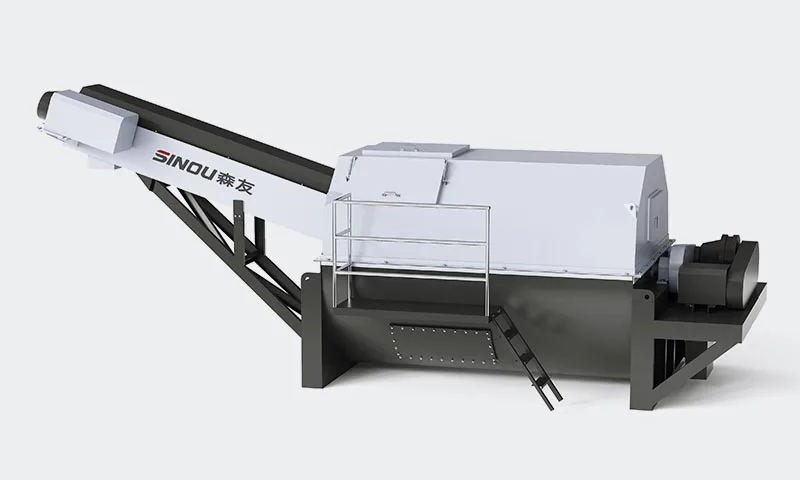
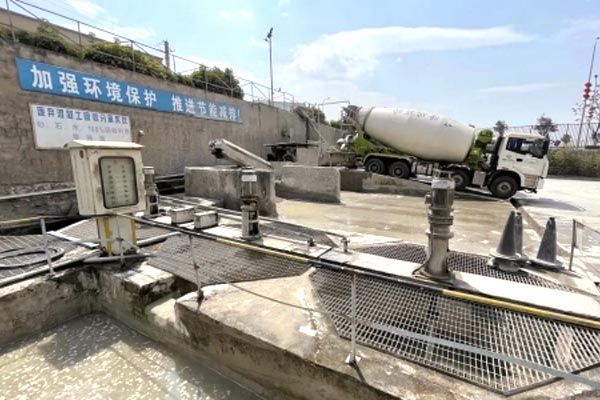
    SINOU’s  Concrete Reclaimer, also named sand-gravel separator, falls into two core series: Rotary Concrete Reclaimer and Vibratory Concrete Reclaimer. It recycles leftover concrete from mixer trucks, separating reusable stone, sand and wastewater for cyclic batching plant production, cutting raw material costs and reducing pollution discharge.

    Basic Introduction & Two Main Product Types

    SINOU Concrete Reclaimer, also universally known as sand-gravel separator, is core recycling equipment specially developed for concrete batching plants to treat residual concrete leftover inside mixer trucks. It realizes full separation of reusable coarse aggregate, fine sand and washing wastewater, supporting cyclic reuse of raw materials and water resources while cutting solid waste discharge.

    The product line is categorized into two mature structural series: Rotary Concrete Reclaimer and Vibratory Concrete Reclaimer, engineered to match different daily processing loads and site layout demands of mixing stations.

    1. Rotary Concrete Reclaimer

    Its core assembly consists of a rotary stone separation drum and spiral sand conveying auger. The layout supports both forward and reverse installation modes, adaptable to single or dual mixer truck parking stations, enabling flexible layout adjustment according to the actual foundation space of the batching plant. It adopts steady rotary screening mechanics for continuous medium-volume residual concrete recovery.

    2. Vibratory Concrete Reclaimer

    This configuration combines linear vibrating screening units with a matched spiral sand auger. Driven by dual vibration motors, it delivers high-intensity linear screening motion to break apart agglomerated residual concrete. Designed for high-throughput scenarios, it processes larger volumes of waste mixer truck concrete with cleaner aggregate separation effect compared to rotary structures.

    Both series deploy integrated automatic electrical control systems, realizing unattended continuous operation for the full material separation and recovery workflow.

    Working Principle

    1. Rotary Concrete Reclaimer Principle

    ● Waste concrete from mixer trucks flows into the equipment’s feed tank; the rotary stone drum first screens out coarse aggregate (stone >5mm).

    ● Fine sand is conveyed upward via the spiral auger for recycling; screened wastewater flows into sedimentation tanks for water reuse in mixing production.

    ● The whole process runs continuously with low water content in recovered sand and stable material separation efficiency.

    2. Vibratory Concrete Reclaimer Principle

    ● Vibration motors generate high-frequency linear vibration, tossing mixed concrete materials onto the polyurethane screen deck for layered screening.

    ● Oversize stone (>5mm) is discharged separately, fine sand is lifted by auger for reuse; wastewater is fully collected for cyclic utilization.

    ● Linear vibration delivers higher screening intensity, ideal for sites with large daily volumes of residual mixer truck concrete.

    Core Product Features

    1. Rotary Concrete Reclaimer

    ● Low upfront investment cost with outstanding water circulation utilization rate, effectively reducing aggregate and freshwater consumption of concrete mixing stations.

    ● Optimized rotary screening frame structure greatly mitigates sieve aperture blockage issues, maintaining stable separation performance under long-term heavy-duty running conditions.

    ● Equipped with integrated automatic control system, operation procedures are simplified; flexible forward/reverse assembly structure adapts to compact or irregular plant foundation layouts.

    ● Recovered sand features low residual water content, which can be directly applied to concrete batching production without extra dewatering treatment.

    2. Vibratory Concrete Reclaimer

    ● Adopts advanced linear vibration screening principle, achieving cleaner and faster separation of stone and sand compared to rotary type.

    ● Fitted with wear-resistant polyurethane screen panels that deliver extended service life, anti-clogging property and easy internal bin cleaning.

    ● Guided chute feeding structure ensures uniform material distribution across the screen surface for stable high-capacity processing. Open frame door design facilitates rapid inspection, disassembly and daily component maintenance.

    ● Low power consumption design matches high output capacity; automatic discharge structure supports continuous unattended operation for large-volume residual concrete disposal.

    Shared Advantages for Both Types

    ● Complete closed-loop recovery workflow for aggregate and wastewater, complying with environmental protection emission standards.

    ● Robust welded main body structure with wear-resistant lining and auger blades to extend overall equipment service lifespan.

    Product Type Classification

    1. Rotary Concrete Reclaimer

    It adopts rotary drum screening architecture with moderate overall footprint. Oriented for medium-scale concrete mixing stations with regular daily residual concrete treatment volume. The flexible mounting mode fits standard parking bay layouts, delivering stable continuous separation for medium workload scenarios.

    2. Vibratory Concrete Reclaimer

    Equipped with linear vibration screening structure for large-capacity processing. Suited for large commercial mixing plants that generate massive volumes of leftover mixer truck concrete every day. It provides higher hourly handling capacity and superior separation cleanliness to satisfy high-yield production recycling demands.

    FAQ

    Q: What’s the key difference between rotary and vibratory concrete reclaimers?

    A: Rotary models rely on rotary drum screening with lower initial cost, suited for medium workloads. Vibratory units use high-intensity linear vibration for cleaner separation and larger hourly throughput for high-volume plants.

    Q: What particle sizes of aggregate can be recycled?

    A: Recovered stone ≥5mm, recyclable fine sand 0–5mm; separated clean aggregates can be directly reused in concrete batching formulas.

    Q: Is full automatic operation available?

    A: All SINOU Concrete Reclaimer models are equipped with auto electric control systems, no constant manual monitoring required during running.

    Q: Can wastewater from separation be reused directly?

    A: Yes. Separated water flows to sedimentation pools, and clarified water circulates for mixer washing and concrete mixing to save tap water resources.

    Overall Advantages & Market Reputation

    1. Two distinct structural configurations including rotary and vibratory types are available, covering diverse processing capacities to accommodate concrete mixing stations of various scales and operational demands.

    2. The equipment features excellent universal compatibility, which can be seamlessly integrated with wastewater collection tanks, conveying systems and sedimentation facilities of existing batching plants to form a complete closed-loop recovery system.

    3. Adopting robust fabrication techniques and high-wear-resistant components such as spiral augers and screening panels, the equipment delivers long service life and stable running performance. With premium quality and cost-effective pricing, our products have established stable long-term cooperative partnerships with clients from Europe, the Middle East and Southeast Asia.

    Technical Parameter Overview

    Diameter of stone drum

    1000(mm)

    Diameter of Auger

    480(mm)

    Screening ability

    ≤12(m³/h)

    Size of split stone

    >φ5(mm)

    Sand size

    <φ5(mm)

    Stone separator power

    4(kw)

    Sand separator power

    4(kw)

    Dimensions (L*W*H)

    6260*1970*2480 mm

    Total weight

    ≥5 Ton

    Number of Mixer trucks

    <30 Vehicle

    Number of Washing parking

    1-2 Vehicle

    Electric control system

    Auto control

    After-sales, Packaging & Maintenance Tips

    1. A 12-month warranty for whole equipment, remote video installation guidance and lifelong technical support.

    2. Daily maintenance: Clear residual concrete buildup on screen and auger after work shifts; lubricate transmission bearings weekly; replace worn polyurethane screens or auger blades on schedule to sustain stable separation efficiency.

    3. Spare wear parts (screen panels, auger flights, seals, vibration motors) are stocked for fast global delivery to minimize plant downtime.

    Certification & Qualification Introduction

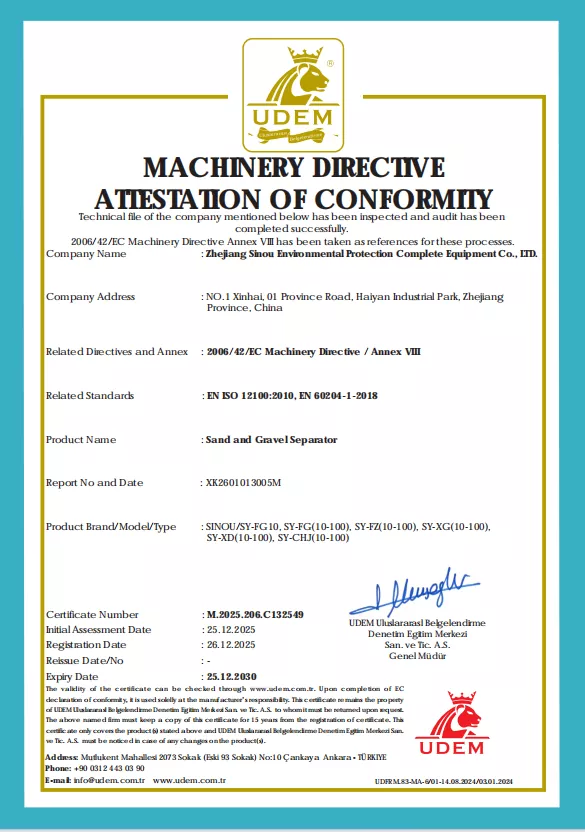
    Our Concrete Reclaimer has passed strict compliance assessment in accordance with 2006/42/EC Machinery Directive, fully meeting the requirements of EN ISO 12100:2010 and EN 60204-1:2018 safety standards.

    The product has obtained official UDEM Machinery Directive Conformity Certificate with valid certification period until December 25, 2030. All production, design and technical documents have been reviewed and approved by the certification authority.

    As a certified manufacturer, Zhejiang Sinou Environmental Protection Complete Equipment Co., LTD strictly implements standardized production procedures. All our sand and gravel separators comply with EU machinery safety regulations, featuring reliable operational safety, stable performance and qualified quality. The valid certification supports product sales, project tendering and market access across European regions and other international markets. Customers can verify the certificate authenticity via the official website of UDEM.

    Concrete Reclaimer Certificate

  • Wastewater System
    Wastewater System

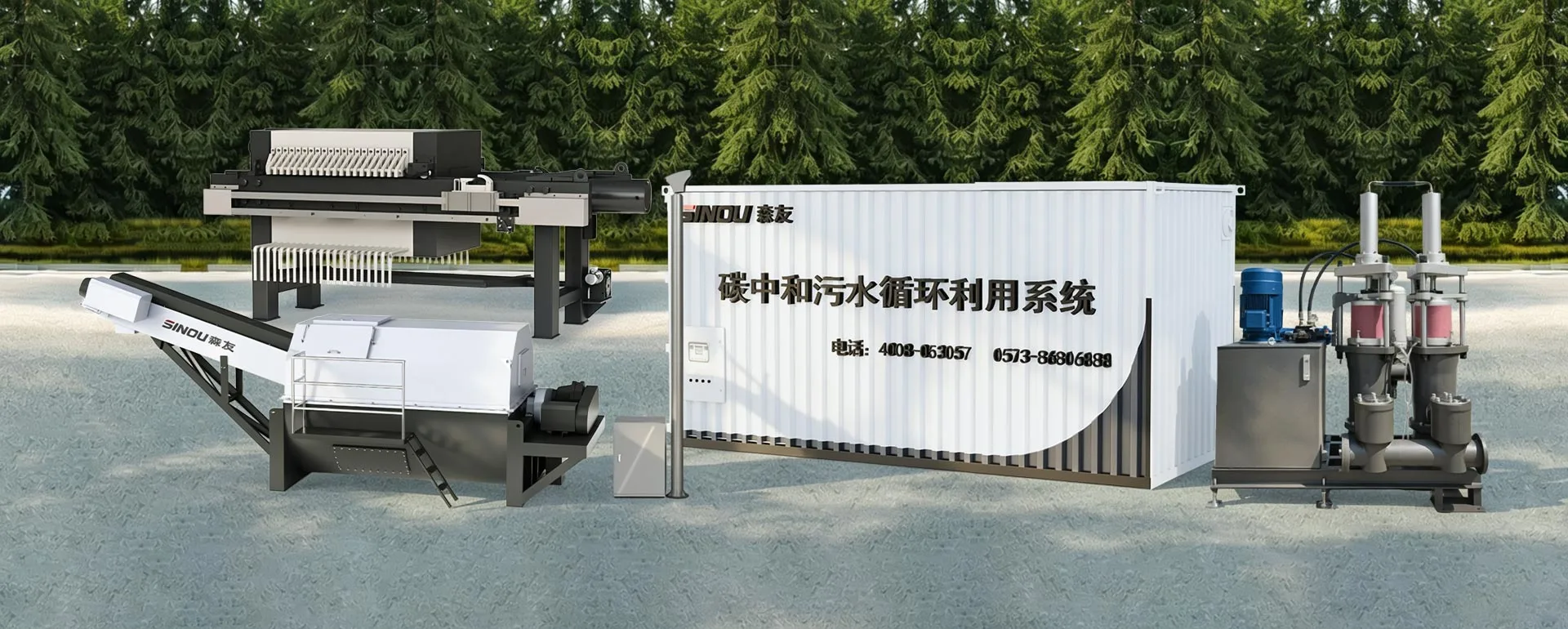
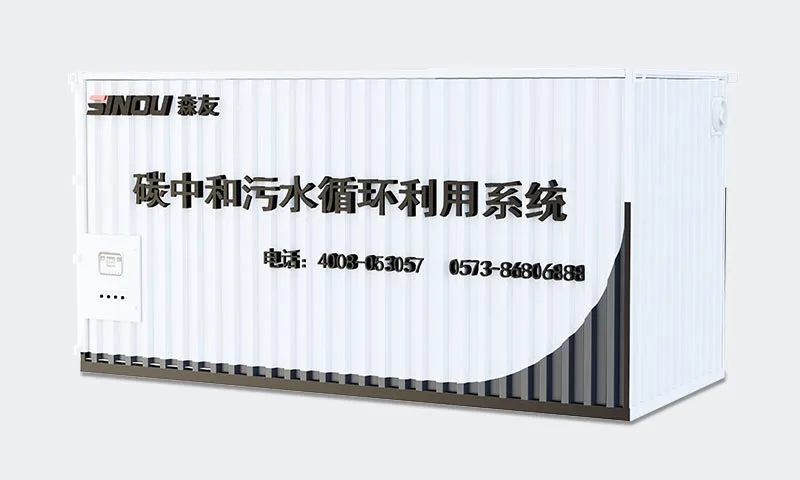
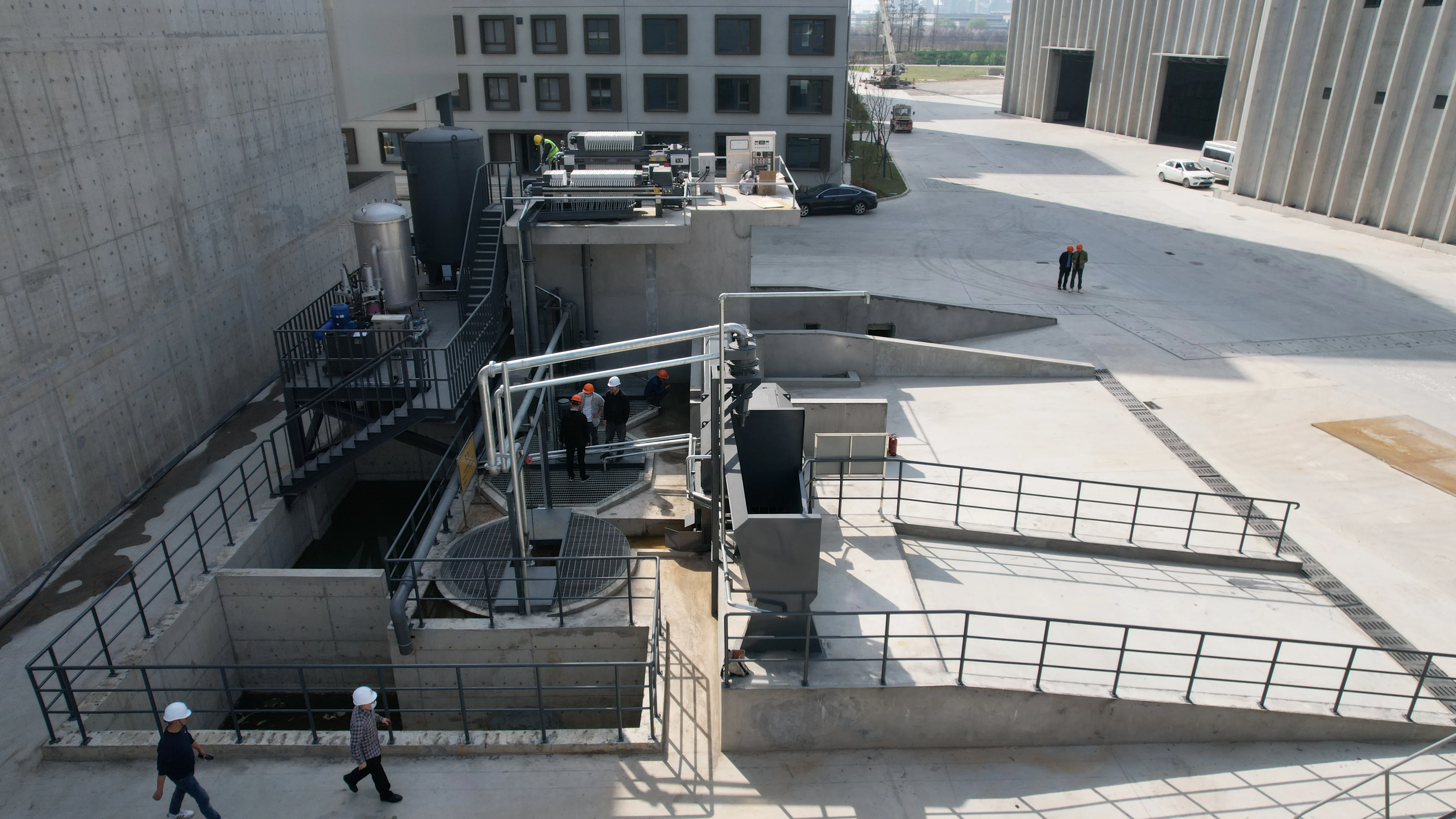
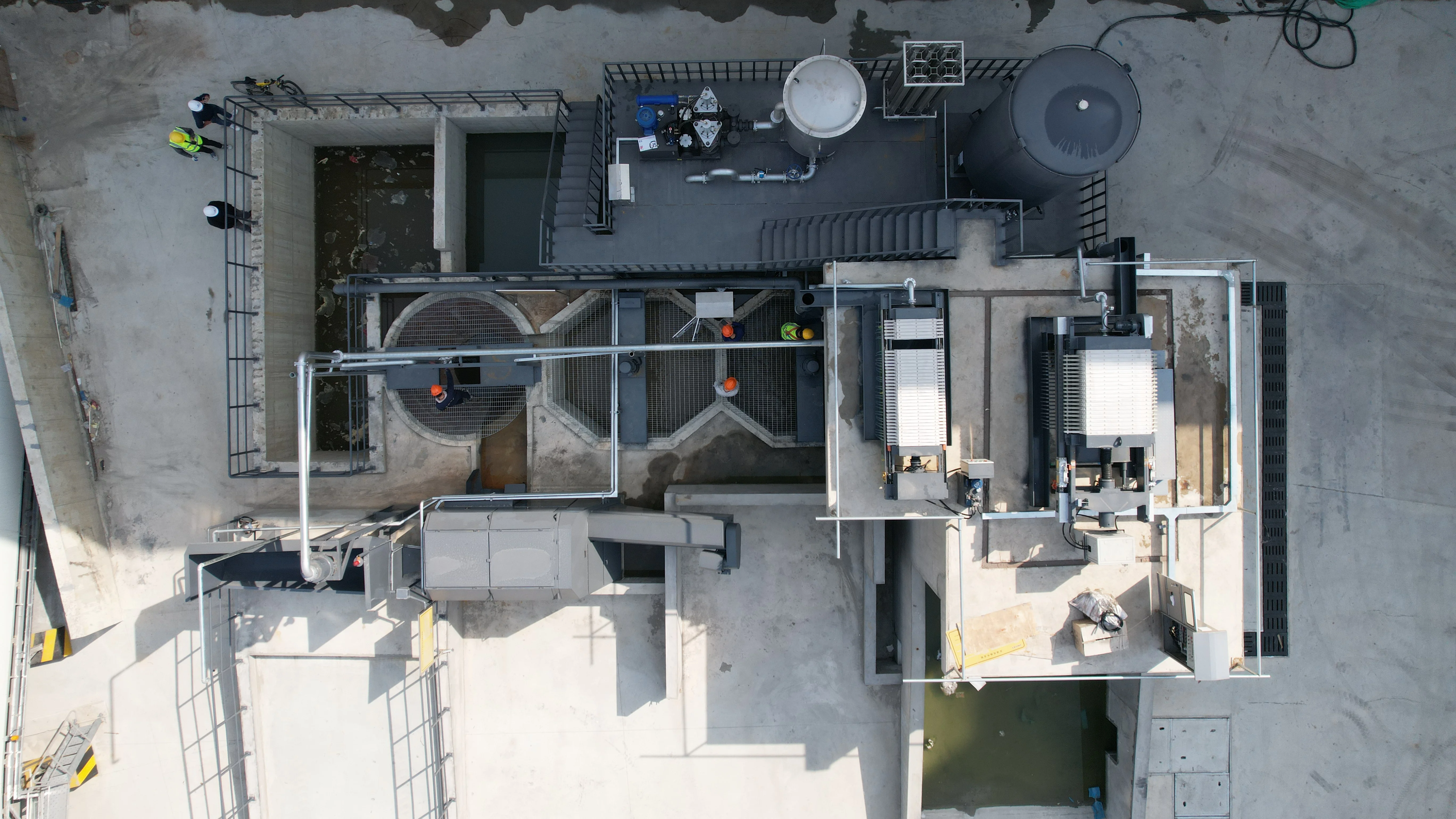
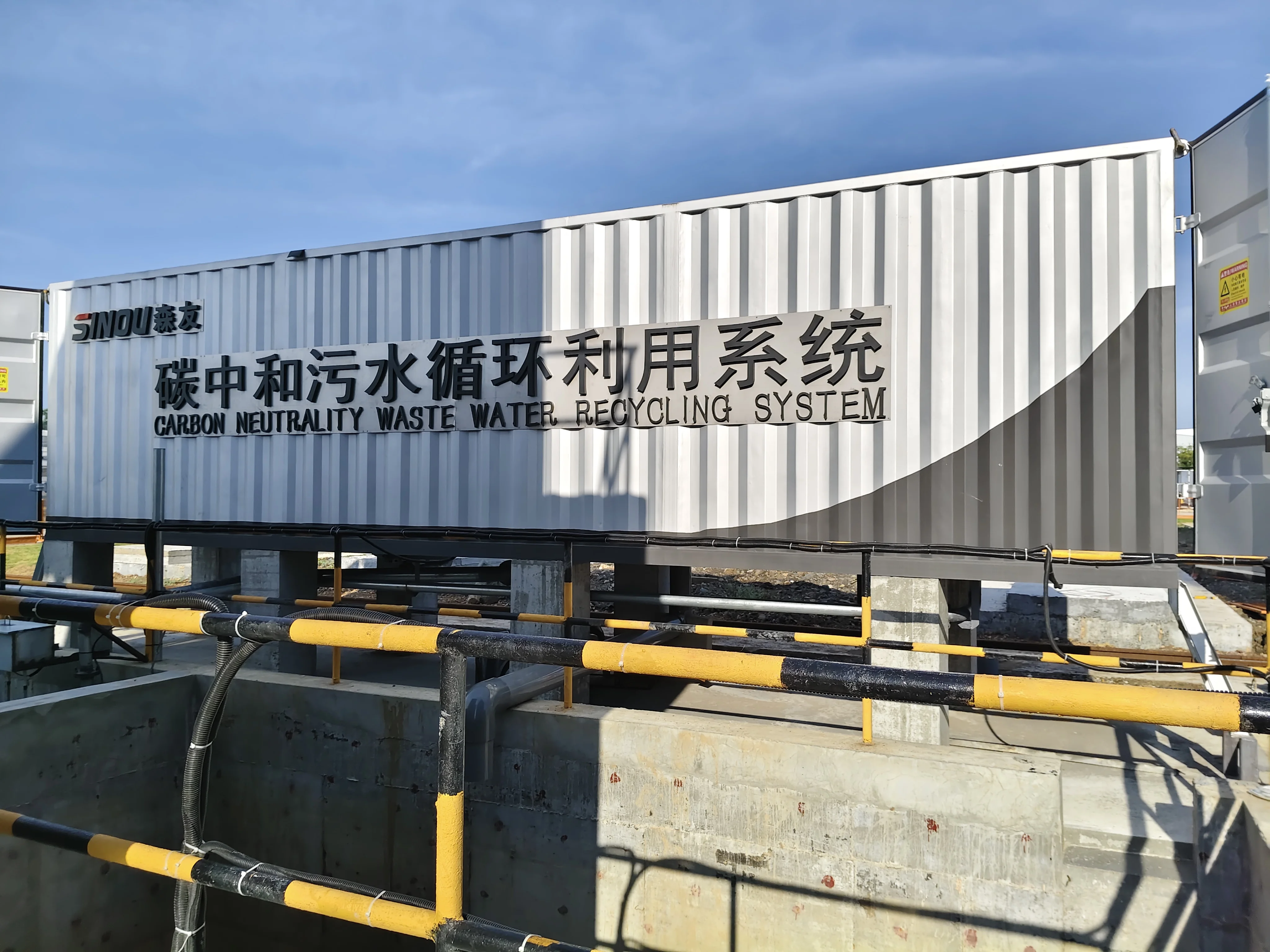
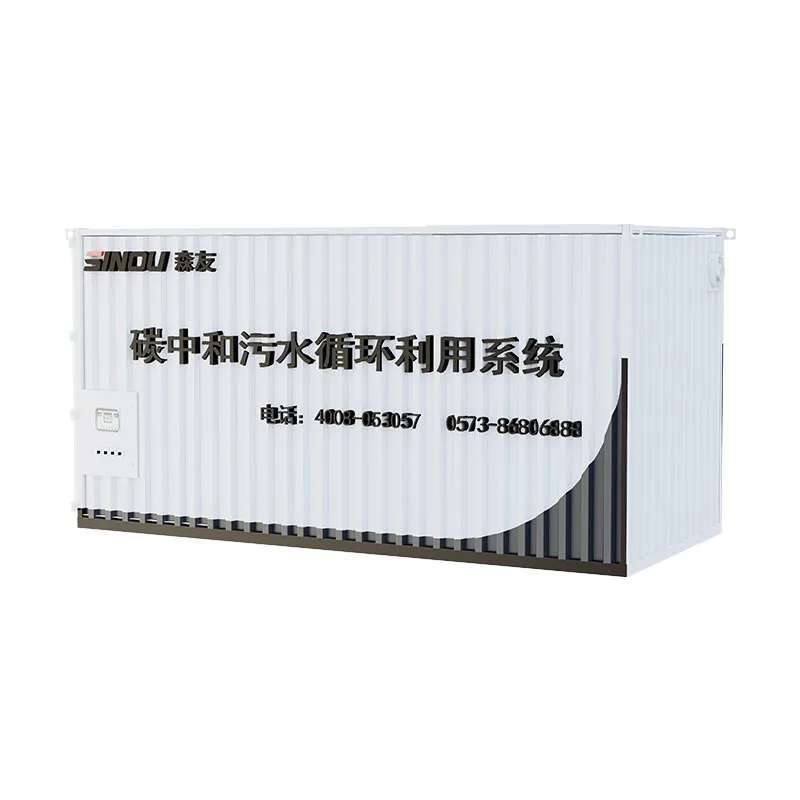
    SINOU Carbon Neutrality Wastewater Treatment System is a containerized integrated neutralization and recycling unit tailor-made for concrete batching plant alkaline wastewater, perfectly supporting the full-set residual concrete recovery & aggregate regeneration system required by the Saudi tender.

    Concrete plant wastewater features ultra-high alkalinity (raw pH 12.5–13) and heavy suspended desert fine silt (50–100μm ultra-fine sand). This wastewater system uses food-grade liquid CO₂ carbonation neutralization technology, replacing traditional caustic soda dosing. It stabilizes effluent pH to 6.5–8.5 for direct production reuse, eliminates secondary pollution, mitigates silt deposition, resolves pump blockage, and lifts long-term system availability above 95%.

    Full Equipment Composition

    The complete skid-mounted water circulation system consists of these core assemblies:

    ● Liquid CO₂ storage tank & vaporizer unit

    ● Pressure reducing & gas delivery power plant

    ● Two-stage cascade reaction reactor

    ● High-pressure plunger feed pump set

    ● PH online transmitter & real-time monitoring probe

    ● Radar level gauge for pool liquid level interlock control

    ● PLC+MCC electronic automatic control cabinet, HMI touch screen & mobile APP remote control

    ● Pressure safety control system & gas-liquid solenoid valves

    ● Solid-liquid filter press / slurry filter for silt dewatering

    ● Supporting raw water tank, transition buffer tank, clean water reuse tank & pipeline framework

    Complete Working Flow & Process Description

    Step 1: Raw Water Collection & Pre-Filtration

    Highly alkaline wastewater containing massive ultra-fine desert silt flows from the concrete recovery line into the raw water tank. Large flocs and coarse solids are pre-intercepted; soluble silt-laden wastewater is pumped to the reaction module via the plunger feed pump.

    Step 2: CO₂ Atomization & Two-Stage Neutralization

    Liquid CO₂ is vaporized into gaseous CO₂, pressure-regulated and injected into the sealed two-stage reactor. Alkaline wastewater is atomized inside the tower and fully mixed with CO₂ gas: High-alkali calcium hydroxide from cement & desert sand reacts to form insoluble calcium carbonate silt, lowering pH steadily. Real-time PH probes feed signals back to the PLC to auto-adjust CO₂ gas flow for precise pH stabilization.

    Step 3: Buffer Sedimentation & Slurry Separation

    Neutralized water overflows into the transition tank; precipitated carbonate-sand slurry sinks to the tank bottom. Periodically, concentrated slurry is pumped into the solid-liquid filter press unit. Filter cake (mixed sand & carbonate sludge) is dewatered for solid waste disposal; filtrate flows back to the raw water tank for reprocessing.

    Step 4: Final Polishing & Clean Water Reuse

    Supernatant clarified water from the transition tank flows into the clean water pool. Treated water meets concrete mixing reuse standards, pumped back to mixer truck washing, aggregate washing, and batching production lines to realize 100% water closed-loop circulation.

    Step 5: Full Automatic Interlock Control

    Radar level gauges monitor liquid levels across all pools; PH transmitters, gas pressure sensors, pump running signals interlock with the PLC system to auto-adjust pump speed, CO₂ flow, and slurry discharge cycles. Manual/automatic dual operation modes are available, with remote mobile APP monitoring and fault alarm.

    Core Technical Advantages

    (1) Precise CO₂ neutralization, zero secondary pollution, low operation cost

    No alkaline chemical additives like sodium hydroxide. CO₂ carbonation creates stable carbonate precipitates, avoids over-dosing pH fluctuation, cuts chemical consumption cost.

    (2) Specialized anti-silt-deposition design for 50–100μm desert fine sand

    Two-stage reactor with turbulent mixing prevents ultra-fine sand adhesion to tank walls; transition tank adopts sloped anti-silt bottom structure + timed slurry pumping cycle.

    (3) Full anti-clogging protection for circulating pumps

    Pre-filter screens before pump suction ports + variable-frequency plunger pump with large flow passages; neutralization flocculation aggregates tiny desert sand particles into larger settleable flocs, reducing fine particle abrasion and blockage of pump impellers and pipeline elbows.

    (4) High system availability ≥95% as tender specified

    Robust corrosion-resistant material construction for all wetted parts (anti-alkali, anti-silt abrasion); automated self-clean slurry discharge cycles reduce manual maintenance frequency drastically vs conventional wastewater systems. Long service life with minimal downtime.

    (5) Large matching handling capacity perfectly fits project demand

    Standard processing water flow 30–60m³/h. Gas flow adjustable 50–500m³/h to cope with fluctuating peak wastewater output from 3 sets of 150m³/h mixing plants.

    (6) Fully automated unattended operation

    PLC+HMI local control + mobile APP remote real-time monitoring, fault self-diagnosis and alarm.

    (7) Containerized integrated skid layout

    Compact pre-assembled container frame. fast on-site installation without complex civil foundation modification.

    Official Technical Parameter Table

    Parameter Item

    Technical Value

    CO₂ Gas Flow Adjustment Range

    50 ~ 500 m³/h

    Rated Wastewater Treatment Capacity

    30 ~ 60 m³/h

    Operation Control Mode

    Manual / Automatic switchable

    Overall Control System

    PLC electronic automation + Mobile APP remote monitoring

    Total Installed Power

    20 ~ 50 kW

    Effluent Neutralization PH Range

    6.5 ~ 8.5 (fully compliant for concrete production reuse)

    Input Raw Wastewater PH Adaptation

    12.5 ~ 13

    Power Supply Standard

    3 Phase, 380V, 60Hz (compatible with site synchronous generator power)

    Matching Collaboration with Aggregate Recovery System

    This carbon neutrality wastewater unit forms a complete closed-loop resource regeneration line with our Rotary Concrete Reclaimer / Vibratory Concrete Reclaimer:

    ● Wastewater discharged from sand-gravel separators feeds directly into this neutralization system’s raw water tank;

    ● Ultra-fine 50–100μm desert sand captured in neutralization sediment is partially recoverable back to aggregate stockpiles; excess sludge is filter-pressed for low-cost solid waste disposal, minimizing waste volume;

    ● Fully recycled clean water cycles back to wash mixer trucks, flush separators, and feed concrete batching, slashing freshwater purchase consumption and environmental discharge fees;

    ● Unified MCC central control cabinet realizes synchronous start-stop interlock between the aggregate recovery host and wastewater treatment system for whole-line coordinated automatic operation.

    Maintenance & Quality Assurance Compliance

    ● Warranty term: Minimum 3-year full equipment warranty from acceptance completion, matching tender warranty rules.

    ● 2-year spare parts package: We supply a complete recommended spare parts list covering two full years of continuous operation, with formal unit pricing and confirmed lead time for spare delivery to Saudi Arabia.

    ● After-sales service: Overseas engineer on-site installation guidance, full equipment commissioning, hands-on operator training programs, dedicated dispatched technical support staff for site startup.

    ● HCC Gulf Region project track record: We provide authenticated reference cases for Saudi Arabia and other GCC states with existing desert sand concrete plant wastewater neutralization & recycling installations, to boost tender evaluation score for local industry experience.

    Product Feature Highlights

    ● Efficient carbon dioxide neutralization to stabilize water PH

    ● Eco-friendly low-carbon process, no secondary pollution

    ● Full automated remote intelligent control system

    ● Mature industrialized technology with stable guaranteed quality

    ● Anti-abrasion & anti-corrosion component materials extend service lifespan

    ● Low chemical input, reduces long-term plant operating expenditure

    ● Containerized modular design for easy overseas transport and rapid field assembly

    FAQ

    Q1: What supporting equipment can this wastewater system work with?

    A: This carbon neutrality wastewater system is independently developed by SINOU, which is perfectly matched with our full series of concrete recycling equipment, including rotary concrete reclaimer, vibratory concrete reclaimer and feeding chutes. It forms a complete closed-loop treatment line for residual concrete and washing wastewater of concrete batching plants. The whole set of equipment adopts unified PLC central control, realizing synchronous linkage operation and easy overall management.

    Q2: What is the applicable treatment capacity of the system? Can it meet the requirements of large mixing plants?

    A: Our standard wastewater system has a processing capacity ranging from 30 m³/h to 60 m³/h, which fully satisfies the water treatment demand of large concrete batching plants with multiple production lines. We also support customized flow design according to actual daily wastewater output to match different plant scales.

    Q3: What is the applicable power supply standard of the equipment?

    A: The system is designed for 3-phase, 380V, 60Hz power supply, which is completely compatible with the synchronous generator power supply commonly used in Saudi Arabia and other Gulf regions. The electrical components have been optimized for unstable voltage of generator sets to ensure stable operation.

    Q4: How does the system treat fine particles below 100μm in desert sand?

    A: We adopt a combined process of multi-stage filtration, coagulation and gravity sedimentation. Firstly, multi-layer precision filter screens intercept most fine sand; then stirring equipment mixes wastewater with coagulant to gather scattered micro-particles into large flocs.

    After natural sedimentation in the horizontal sedimentation tank, the residual tiny particles are trapped by the front-end filter of the pump. Finally, all sludge containing fine sand is transported to the filter press for deep dewatering, realizing full disposal of particles below 100μm without leakage.

    Q5: Why does the solution not adopt hydrocyclone and inclined tube sedimentation tank?

    A: Combined with the actual working conditions of desert fine sand and SINOU’s mature technical route, we cancel hydrocyclone and inclined tube structures. The horizontal sedimentation tank with large volume is equipped with full-time stirring devices, which extends the hydraulic retention time and ensures sufficient settlement of ultra-fine sand.

    This design simplifies the equipment structure, reduces failure points and daily maintenance workload, and is more suitable for long-term continuous operation in harsh desert environments.

    Q6: What measures are taken to prevent sediment accumulation inside tanks and pools?

    A: We take multiple anti-sediment measures. All water tanks adopt sloped cone-bottom structure without dead corners, and the inner wall is coated with anti-stick and wear-resistant coating. Every tank is equipped with dedicated stirring devices to keep the water body flowing dynamically all the time.

    Meanwhile, the system is fitted with liquid mud level monitors and automatic mud discharge valves, which regularly discharge sludge to the filter press. It fundamentally avoids long-term deposition and compaction of sediment.

    Q7: How to solve the blockage problem of water pumps caused by a large amount of fine sand?

    A: There are multiple protection measures for pump anti-clogging. First, multi-stage filters are installed at the pump inlet to block sundries and agglomerated mud.

    Second, we use SINOU’s self-developed hydraulic ceramic plunger pump with large flow passages and excellent anti-abrasion performance, which is not easy to be stuck by fine particles.

    In addition, the stirring device will run in advance before the pump starts to stir up the bottom sediment, preventing instantaneous mud suction and blockage. The system also has overload and stall protection to stop the machine automatically in case of abnormal conditions.

    Q8: Will fine sand cause serious wear to pipeline and equipment?

    A: All flow-passing parts in contact with sewage and fine sand are made of high wear-resistant materials. The inner wall of pipelines and tanks is treated with anti-abrasion coating.

    Combined with the pre-filtering process, the content of free fine sand in the water is greatly reduced, which effectively lowers the wear rate of the whole system and extends the service life.

    Q9: Is it necessary to equip stirring systems for the whole set of equipment? What are their functions?

    A: Stirring systems are standard configurations for all tanks and pools. The stirrers in the water collection tank and concentration tank prevent fine sand from settling and compacting; the stirrers in the reaction tank ensure the full mixing of carbon dioxide, coagulant and wastewater, so as to guarantee the neutralization and flocculation effect.

    All stirring devices are interlocked with pumps and mud discharge valves to realize fully automatic operation.

    Q10: Why choose filter press for sludge treatment? What are the advantages?

    A: The filter press is the core equipment for terminal sludge disposal. It can squeeze high-concentration mud containing ultra-fine sand into dry mud cakes, realizing thorough solid-liquid separation. The filtrate flows back to the front-end pool for recycling, achieving zero sewage discharge.

    The fully automatic filter press supports unattended operation, with large sludge processing capacity and stable performance, which is the optimal choice for continuous production of mixing plants.

    Q11: What technology is used for wastewater pH neutralization? Is there secondary pollution?

    A: This system adopts carbon dioxide neutralization technology, which is our core carbon neutrality solution. The alkaline substances in cement wastewater react with CO₂ to generate water and harmless carbonate sediment.

    No caustic soda and other chemical agents are added during the whole process, so there is no secondary pollution, which meets local environmental protection standards in the Gulf region.

    Q12: What is the pH range of the recycled water? Can it be reused for concrete production?

    A: The raw alkaline wastewater from mixing plants has a pH value of 12.5~13. After CO₂ neutralization treatment, the pH of the effluent is stably controlled between 6.5 and 8.5.

    The recycled water fully meets the water quality standards for concrete batching and mixer truck cleaning, and can be directly reused in the production link.

    Q13: What is the daily maintenance work of the wastewater system? Is the maintenance difficult?

    A: The overall maintenance work is simple. Daily work mainly includes inspecting the operating status of pumps and stirrers, checking filter screens and conducting backwashing, and observing liquid level and pH data.

    Weekly and monthly maintenance focuses on lubrication, instrument calibration and bolt fastening. We have formulated a complete hierarchical maintenance plan, and the operation and maintenance personnel can get started quickly after professional training.

    Q14: What is the recommended maintenance cycle of the equipment?

    A: We adopt five-level maintenance management: daily inspection, weekly routine maintenance, monthly partial overhaul, quarterly component inspection and annual full-system overhaul. The wearing parts such as filter screens, filter cloths, pump seals and stirring blades have clear replacement cycles, which can effectively ensure the overall operation rate of the equipment above 95%.

    Q15: What is the warranty period of the equipment? What after-sales support can be provided?

    A: The whole set of wastewater system enjoys a 3-year full warranty . We provide overseas on-site installation guidance, equipment commissioning and professional operator training. A complete list of spare parts for two years of operation is provided together with the equipment, and we guarantee fast delivery of spare parts to the Gulf region.

    Q16: Can the system realize unattended operation?

    A: Yes. The whole system adopts PLC + HMI intelligent control, with full automatic linkage of stirring, water pumping, mud discharging and filter pressing. It supports real-time remote monitoring and fault alarm, realizing 24-hour unattended continuous operation, which greatly saves labor costs for the plant.

    Q17: What are the advantages of this system compared with traditional wastewater treatment equipment?

    A: Firstly, it targets the pain points of desert ultra-fine sand, with perfect anti-sedimentation and anti-clogging design and higher equipment operation rate.

    Secondly, carbon dioxide neutralization technology saves chemical costs and is more environmentally friendly.

    Thirdly, the equipment structure is simplified without redundant units such as hydrocyclones, so the failure rate and long-term maintenance cost are lower.

    In addition, the compact layout is convenient for transportation and on-site installation.

  • Filter Press
    Filter Press

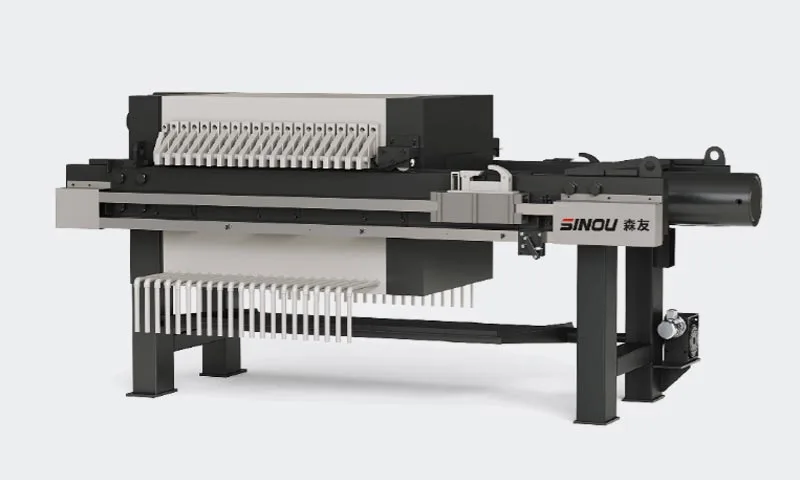
    SINOU Filter Press is a professional high-pressure solid-liquid separation equipment widely used for industrial sludge dewatering. Adopting mature hydraulic compression filtration technology, this filter press separates solid particles and water efficiently from various types of sludge.

    It turns fluid sludge into dry filter cakes and recycles clean filtrate, realizing resource reuse and waste reduction. Designed for long-duration heavy-duty operation, the filter press features stable performance, simple structure and easy operation.

    It is an essential core unit for wastewater treatment, environmental protection renovation and solid waste disposal projects across multiple industries. Contact us today to get a factory-direct price.

    Working Principle & Operation Flow

    This filter press works based on mechanical pressure filtration. The complete working cycle runs automatically as follows:

    ● Slurry Feeding: Sludge is pumped into each filter chamber of the filter press until full filling.

    ● High-Pressure Compression: The hydraulic system pushes filter plates to close tightly. Under continuous pressure, water in the sludge penetrates filter cloth and flows out as clean filtrate, while solid materials are trapped inside filter chambers.

    ● Pressure Maintaining: The system holds stable pressure to further reduce moisture content of filter cakes and ensure ideal dewatering effect.

    ● Automatic Cake Discharge: After dewatering is completed, filter plates open automatically, and dry filter cakes drop down for collection and transportation.

    ● Cycle Reset: The equipment cleans filter cloth automatically and returns to standby status for the next working cycle.

    Structural Composition & Product Details

    (1) Heavy-Duty Main Frame

    The main frame is made of thick steel plates with full welding and stress relief treatment. It owns high structural rigidity and strong compression resistance, never deforming under long-term high pressure.

    The whole frame is treated with anti-rust and anti-corrosion paint, adapting to humid, dusty and corrosive working environments. The compact layout saves installation space and suits various workshop conditions.

    (2) Filter Plate & Filter Cloth Assembly

    High-strength polypropylene filter plates are adopted. They feature excellent acid resistance, alkali resistance, wear resistance and aging resistance. Uniform chamber design guarantees even pressure distribution and no slurry leakage.

    The matched filter cloth is selected according to different sludge characteristics. It has good permeability and outstanding interception capacity for fine particles. The modular design allows quick disassembly, cleaning and replacement.

    (3) Hydraulic Drive System

    Equipped with integrated hydraulic station, the system provides stable and powerful pressing force. Hydraulic components operate smoothly with low noise and low failure rate.

    It supports automatic pressure adjustment and constant pressure maintenance, which can be flexibly set to match different sludge properties and dewatering requirements. All hydraulic pipelines are well sealed to prevent oil leakage.

    (4) Automatic Plate Shifting Mechanism

    The automatic plate shifting device drives filter plates to open and close flexibly. It runs stably without jamming, realizing automatic cake discharge. Optional auxiliary vibration structure is available for sticky sludge to ensure thorough unloading of filter cakes.

    (5) Intelligent Control System

    The filter press is equipped with PLC and HMI control cabinet. It supports one-key automatic operation and manual mode switching. Real-time operating data, pressure parameters and running status can be viewed on the touch screen directly.

    Built-in overload, overpressure and fault alarm functions protect the whole equipment effectively.

    (6) Automatic Cleaning System

    Standard high-pressure water cleaning device is configured. It cleans filter cloth thoroughly after each working cycle to remove attached sludge and fine particles, preventing mesh clogging and maintaining stable filtration efficiency for a long time.

    Core Product Advantages

    (1) Superior Dewatering Performance

    High-pressure filtration realizes thorough solid-liquid separation. The finished filter cake has low moisture content, convenient for transportation and subsequent disposal. It works well even for sludge containing a large number of fine particles.

    (2) Fully Automatic Operation

    The whole process from feeding, pressing, dewatering to cake discharging and cloth cleaning is completed automatically. It supports 24-hour unattended operation and greatly cuts labor costs.

    (3) Strong Environmental Adaptability

    All key components adopt anti-corrosion and wear-resistant materials. The equipment can run stably in high-alkali, high-salt, dusty and other harsh working conditions with low failure rate and high operational availability.

    (4) Energy Saving & Eco-Friendly

    Low power consumption during operation. The separated filtrate can be recycled for production use, achieving zero liquid discharge and complying with global environmental regulations.

    (5) Easy Maintenance & Long Service Life

    Modular component design simplifies daily inspection and parts replacement. High-quality raw materials and precise manufacturing extend the overall service life and reduce long-term operating costs.

    (6) Flexible Matching Capacity

    Multiple models with different filter areas are available. The equipment can be flexibly matched with sludge tanks, stirring devices, feeding pumps and pipeline systems to form a complete sludge treatment line.

    Product Classification

    (1) Standard Automatic Filter Press

    General-purpose model with medium filter area and standard configuration. Cost-effective and widely applied for conventional industrial sludge treatment projects.

    (2) Large-Capacity Filter Press

    Enlarged filter area and increased filter plates. Designed for projects with large daily sludge output and high continuous processing demands.

    (3) Compact Filter Press

    Optimized overall size and compact structure. Suitable for sites with limited installation space, such as renovated workshops and small-scale treatment stations.

    (4) Dual Control Filter Press

    Supports automatic and manual dual operation modes. Easy for equipment debugging, routine inspection and special working condition handling.

    Application Scope

    (1) Concrete batching plant wastewater & sludge treatment

    (2) Municipal sewage treatment projects

    (3) Chemical, printing and dyeing, electroplating industry sludge disposal

    (4) Mining, coal washing and aggregate processing lines

    (5) Food, pharmaceutical and other industrial solid-liquid separation

    (6) All industries requiring sludge dewatering and waste water recycling

    Matching Equipment

    ● Sludge collection tank & stirring system

    Hydraulic plunger pump / slurry feeding pump

    ● Water supply pipeline & control valves

    ● Material conveying equipment for filter cakes

    Frequently Asked Questions

    Q1: What types of sludge can this filter press handle?

    A: It is applicable to various industrial sludge, including cement sludge, municipal sewage sludge, chemical corrosive sludge, mining sludge and sludge containing fine sand particles. It has strong universal performance.

    Q2: Can the separated filtrate be reused directly?

    A: Yes. After solid-liquid separation, the filtrate is clear and clean. It can be recycled to production processes or wastewater circulation systems after simple adjustment.

    Q3: Is the filter cloth easy to be blocked by fine sludge?

    A: We adopt targeted filter cloth for different sludge. Equipped with automatic high-pressure cleaning system, the filter cloth is cleaned after each cycle, which effectively avoids clogging and ensures long-term stable operation.

    Q4: Is the equipment easy to operate for new staff?

    A: The control interface is intuitive and simple. With one-key automatic operation, operators can master daily use after short-term training.

    Q5: Can the equipment work under continuous running conditions?

    A: Definitely. The whole machine is designed for heavy-duty continuous operation. With reliable components and reasonable structural design, it can run stably for long hours.

    Operation & Routine Maintenance

    (1) Daily Operation Rules

    ● Check filter plates, filter cloth and hydraulic oil level before startup, and remove foreign matters inside filter chambers.

    ● Start the equipment and observe the whole automatic cycle of feeding, pressing and cake discharging.

    ● Inspect pipelines, hydraulic parts and plate joints for slurry leakage or oil leakage during operation.

    ● Run the automatic cleaning program after shutdown to clean residual sludge on filter cloth.

    (2) Hierarchical Maintenance

    Daily Maintenance

    Check running sound, vibration and operating pressure. Keep the equipment and surrounding area clean.

    Weekly Maintenance

    Add lubricant to bearings and transmission parts. Tighten all connecting bolts and flanges. Inspect filter cloth and cleaning nozzles. Calibrate control instruments.

    Monthly Maintenance

    Check wear and aging of hydraulic hoses and sealing rings. Inspect filter plates for damage. Test alarm and safety protection functions.

    Quarterly Maintenance

    Replace hydraulic filter elements. Inspect overall frame structure. Debug automatic operation programs.

    Annual Overhaul

    Carry out full disassembly inspection for hydraulic and transmission systems. Replace severely worn parts. Perform overall derusting and repainting for the frame.

    (3) Recommended Wearing Parts Replacement Cycle

    ● Filter cloth: 5 ~ 8 months

    ● Hydraulic sealing rings & bearings: 8 ~ 10 months

    ● Hydraulic filter element: 6 months

    ● Guide rail accessories: 10 ~ 12 months

    Certification & Market Reputation

    All SINOU filter presses are manufactured in accordance with international industrial standards and have passed CE, ISO and other authoritative certifications. Complete qualification documents support overseas customs clearance, project bidding and third-party inspection.

    With reliable quality, stable dewatering performance and competitive cost performance, our filter presses have been exported to Europe, the Middle East, Southeast Asia and other regions.

    We have established long-term cooperative relationships with numerous industrial manufacturers, environmental engineering companies and wastewater treatment contractors. Customized solutions are available to meet personalized on-site requirements.

  • Mixer Truck Washing Machine
    Mixer Truck Washing Machine

    As a manufacturer and supplier in China, SINOU's Fully Automatic Mixer Truck Washing Machine is a dedicated high-pressure cleaning device tailor-made for ready-mix concrete mixer trucks and various heavy engineering vehicles. Different from ordinary civilian car wash equipment, it adopts touchless high-pressure spray technology and load-bearing reinforced structure, targeting thick cement slurry, sticky mud and dust attached to mixer truck tires, chassis, mixing drum and feed hopper.

    Equipped with an integrated circulating water treatment system, this machine realizes water recycling and zero sewage discharge. It supports automatic induction startup, full-range dead-angle cleaning and fast cycle operation. It is an essential environmental protection and efficiency-improving device for concrete batching plants, construction yards, mining areas and large vehicle fleets.

    Our products have been widely exported to the Middle East, Europe, Southeast Asia and other regions, and have passed multiple international certifications. They are well received by customers for stable performance, water-saving and environmental protection, and low failure rate.

    How It Works & Operational Process

    This mixer truck washing machine adopts infrared induction + PLC intelligent control, combined with multi-angle high-pressure spray and circulating water filtration technology. The full automatic working cycle is as follows:

    (1) Vehicle Sensing & Startup: When the mixer truck drives into the designated washing area, the infrared sensor automatically identifies the vehicle and triggers the whole system to start. The driver does not need to get off the truck.

    (2) 360° High-Pressure Cleaning: Multi-directional nozzles on both sides, bottom and top spray high-pressure water jets simultaneously. The high-speed water flow strips cement dirt, mud and dust from the tires, chassis, car body and mixing drum.

    (3) Sewage Collection & Recirculation: The washed sewage flows into the underground sedimentation tank and multi-stage filter device. After removing mud and sundries, the clean water is pumped back to the high-pressure water pump for recycling.

    (4) Auto Shutdown & Reset: After the preset cleaning duration ends, the spray system stops automatically. The vehicle drives away, and the whole machine returns to the standby state, waiting for the next vehicle.

    (5) The whole process is unmanned, with a single cleaning cycle controlled within 60–90 seconds, which greatly improves the vehicle passing efficiency of the mixing plant.

    Build & Component Details

    (1) Reinforced Bearing Base & Main Frame

    The load-bearing base is made of thickened national standard steel plate + reinforced I-beam, with overall anti-rust treatment. The standard load capacity reaches 80–120 tons, which can fully adapt to fully loaded mixer trucks.

    The overall frame adopts welded structure with high rigidity, no deformation after long-term rolling of heavy vehicles. The outer shell is made of corrosion-resistant steel plate, suitable for outdoor long-term wind and rain exposure.

    (2) High-Pressure Water Supply & Spray Assembly

    Equipped with industrial-grade high-pressure water pump group, the stable water pressure is maintained at 100–120 bar. The whole machine is equipped with dozens of directional spray nozzles, which are scientifically arranged around, bottom and top to form a three-dimensional spray network.

    The nozzles are made of wear-resistant alloy, not easy to block, and can clean the tire tread, chassis gap and mixing drum without dead angles.

    (3) Sensing & Intelligent Control Unit

    Adopts high-sensitivity infrared radar sensor, with strong anti-interference ability, not affected by light and dust. The core control part is a dedicated PLC controller + touch panel. Users can freely set cleaning time, water pressure and spray mode.

    It has built-in functions such as overload protection, pump dry-running protection and fault self-alarm, which ensures safe operation. It can also be connected to the factory central control system for remote monitoring.

    (4) Recirculating Water & Sludge Removal Unit

    Matching multi-stage sedimentation tank and automatic mud scraper. The sewage generated by cleaning is filtered and precipitated layer by layer. The sludge is regularly discharged by the mud removal device, and the clean water is recycled.

    The water recycling rate is over 90%, which saves a lot of tap water. The pipeline is made of high-pressure resistant HDPE pipe, which is anti-corrosion and anti-scaling.

    (5) Splash Guard & Enclosure System

    Optional fully enclosed splash-proof enclosure to prevent high-pressure water and mud from splashing around, keep the site clean and meet local environmental inspection requirements. The enclosure is equipped with quick-assembly structure, easy to disassemble and transport.

    (6) Auxiliary Fittings & Detection Parts

    Equipped with water level gauge, pressure gauge, filter screen and other auxiliary detection and filtering parts. All electrical components are waterproof and dustproof, adapting to harsh outdoor working conditions.

    Key Strengths & Unique Features

    (1) Super Load-bearing & Durable Structure: Reinforced heavy-duty design, load capacity up to 120 tons, specially designed for frequent rolling of full-load mixer trucks. The overall structure is sturdy and durable with low failure rate.

    (2) Touchless Full-range Cleaning: High-pressure three-dimensional spray, no contact with brushes, which avoids scratching the car body and mixing drum paint. The mud removal rate of tires and chassis is over 98%.

    (3) Intelligent Unmanned Operation: Infrared automatic induction, one-button parameter setting. The driver can finish cleaning without getting off the truck, saving labor and improving vehicle passing efficiency.

    (4) Water-saving & Eco-friendly Circulating System: Built-in multi-stage sedimentation and filtration device, water recycling rate >90%, greatly reducing water costs and realizing zero sewage discharge.

    (5) Fast Cleaning Speed: A single vehicle only takes 60–90 seconds, supporting 60+ vehicles per hour, perfectly matching the high-frequency vehicle access of large mixing plants.

    (6) Strong Environmental Adaptation: All components are waterproof, dustproof and anti-corrosion. It can operate stably for long time in high-dust, muddy outdoor environments, adapting to high temperature and rainy weather.

    (7) Easy Installation & Flexible Layout: Divided into foundation type and foundation-free type. The foundation-free model does not require complicated civil works, which can be quickly put into use and is convenient for site relocation.

    (8) Low Comprehensive Maintenance: The nozzle is not easy to block, the vulnerable parts are few, and the daily maintenance is simple, which reduces the long-term operating cost.

    Product Range & Technical Specs

    (1) Product Range

    ① Standard Foundation-Mounted Washer

    Requires simple civil foundation, super load-bearing, stable operation. Suitable for fixed large concrete batching plants and long-term operating vehicle fleets. It is the most widely used standard model.

    ② Mobile Foundation-Free Washer

    No need to dig sedimentation tanks and embedded parts. The whole machine is integrated, which can be hoisted and moved as a whole. Ideal for temporary construction yards, mobile mixing stations and frequently replaced sites.

    ③ Full Enclosed Wash System

    Add a fully enclosed splash-proof enclosure on the basis of the standard model to prevent water and mud splashing. Suitable for urban mixing plants and areas with strict environmental requirements.

    ④ Long Tunnel Type Washer

    Extended spray channel, suitable for ultra-long mixer trucks and multi-vehicle continuous flow operation, for large-scale centralized vehicle washing areas.

    (2) Main Technical Specs

    Parameter Item

    Standard Specification

    Rated Load Capacity

    80 Ton / 120 Ton (Optional)

    Working Water Pressure

    100 ~ 120 bar

    Single Cleaning Time

    60 ~ 90 seconds

    Hourly Washing Capacity

    60 ~ 80 vehicles

    Water Recycling Rate

    ≥ 90%

    Power Supply

    380V/50Hz / 380V/60Hz (Global Universal)

    Control Mode

    Infrared Automatic Induction + PLC Manual Control

    Spray Form

    360° Three-dimensional Touchless Spray

    Working Environment

    Outdoor Waterproof, Dustproof, Anti-corrosion

    Comparative Analysis with Peer Products

    We compare our mixer truck washing machine with brush-type car washer and ordinary low-pressure site washer from multiple dimensions to highlight differentiated strengths.

    (1) Touchless High-pressure Washer VS Brush-type Vehicle Washer

    Comparison Item

    SINOU Touchless Mixer Truck Washer

    Traditional Brush-type Washer

    Cleaning Method

    High-pressure water spray, no physical contact

    Rotating brush friction cleaning

    Damage to Vehicle

    Zero damage to paint and mixing drum

    Brushes easily wear paint and scratch metal surfaces

    Adapt to Stains

    Excellent for cement slurry and thick mud

    Poor cleaning effect on hardened cement

    Service Life of Vulnerable Parts

    Alloy nozzle, long service life

    Brush hair is easy to wear and age, frequent replacement

    Operating Noise

    Low noise during operation

    Large friction noise

    Maintenance Work

    Simple, only regular sludge cleaning

    Need to replace brushes regularly, high maintenance cost

    Applicable Scenario

    Concrete mixer truck professional cleaning

    Ordinary dust vehicles, not suitable for cement dirt

    (2) High-pressure Circulating Washer VS Ordinary Low-pressure Site Washer

    Comparison Item

    SINOU High-pressure Circulating Washer

    Ordinary Low-pressure Site Washer

    Working Water Pressure

    100~120 bar, strong impact

    Below 50 bar, weak flushing power

    Cleaning Effect

    Thorough removal of cement and deep mud

    Only clean surface dust, residual mud in gaps

    Water Recycling System

    Built-in multi-stage circulation, water-saving

    No circulating system, large water consumption and sewage discharge

    Load-bearing Structure

    Reinforced for heavy mixer trucks

    Light structure, easy to deform under heavy load

    Intelligent Level

    Automatic induction, unattended

    Mostly manual start, high labor demand

    Environmental Compliance

    Meet strict emission standards

    Difficult to pass environmental inspection

    Summary

    For concrete mixer trucks with cement slurry and thick mud, the touchless high-pressure circulating washing machine is the optimal choice. It has obvious advantages in cleaning effect, vehicle protection, water saving and environmental protection, and long-term comprehensive cost performance is far higher than traditional equipment.

    Application & Supporting Setups

    (1) Main Application Scenarios

    ● Fixed & mobile concrete batching plants (core application)

    ● Municipal construction sites, road and bridge engineering yards

    ● Mining, sand and gravel plants and large material yards

    ● Large engineering vehicle fleets and logistics parks

    ● Waste treatment plants and port freight terminals

    (2) Complete Supporting Setups

    ① Water Circulation Auxiliary: Multi-stage sedimentation tank, automatic mud scraper, filter screen assembly

    ② Pipeline Matching: High-pressure resistant HDPE water pipes, valves and pressure gauges

    ③ Extended Accessories: Fully enclosed splash-proof enclosure, rainproof canopy, remote monitoring module

    ④ Combined Equipment: Matched with our sand-gravel separator and wastewater treatment system to form a full-set environmental protection solution for mixing plants

    Product Selection Guidance

    (1) Select load capacity according to vehicle weight: For full-load mixer trucks above 50 tons, prefer the 120-ton reinforced model to avoid structural deformation.

    (2) Determine installation type according to site conditions: Fixed mixing plants choose foundation type; temporary sites or frequently moved equipment choose foundation-free mobile type.

    (3) Match configuration based on environmental requirements: Urban areas and regions with strict environmental inspection are equipped with fully enclosed splash-proof enclosure.

    (4) Confirm power standard: Select 380V/60Hz model for Middle East, Saudi Arabia and other regions to adapt to local generator power supply.

    (5) Estimate traffic volume: For fleets with more than 60 vehicles per hour, choose an enhanced high-flow pump set to ensure cleaning efficiency.

    Popular Questions & Answers

    Q1: Will the high-pressure water jet damage the mixer truck's paint and mixing drum?

    A: No. We adopt touchless spray technology without any physical friction. The high-pressure water flow only flushes dirt, which will not scratch the paint and metal surface. It is specially optimized for the frequent cleaning demands of mixer trucks.

    Q2: Is the circulating water system easy to be blocked by cement sludge?

    A: The system is equipped with multi-stage intercepting filter screens and automatic mud scrapers. The sludge is regularly discharged, and the nozzle adopts anti-blocking alloy design. Long-term stable operation can be realized with daily simple cleaning.

    Q3: Can it work normally in rainy and high-temperature outdoor environments?

    A: All electrical components and the overall structure are designed with waterproof, dustproof and high-temperature resistance. It can operate stably in all-weather outdoor environments, adapting to desert high temperature and rainy weather in the Middle East.

    Q4: Does the equipment require complicated civil construction?

    A: We provide two options: foundation type and foundation-free type. The foundation-free model can be put into use after flat ground placement without excavation, which saves construction time and cost.

    Q5: What is the water consumption per vehicle? Is it water-saving?

    A: Relying on the circulating system, the actual fresh water consumption per vehicle is very low. The water recycling rate is over 90%, which can greatly reduce the water cost of the mixing plant.

    Q6: Can the equipment realize remote monitoring and data statistics?

    A: Yes. We can customize the remote monitoring module. Users can view the equipment operating status, washing quantity and fault information in real time to realize intelligent management of the fleet.

    Operation & Maintenance Protocols

    (1) Standard Operation Rules

    ① Before startup, check the water level of the sedimentation tank, the tightness of the pipeline and the nozzle for blockage.

    ② After confirming no abnormality, turn on the automatic induction mode, and the vehicle drives slowly into the washing area.

    ③ Do not park the vehicle in the washing area for a long time to avoid long-term pressure on the load-bearing platform.

    ④ After daily work is completed, flush the pipeline and nozzle with clean water to prevent cement residue from solidifying.

    (2) Hierarchical Maintenance Schedule

    ① Daily Maintenance

    ● Clean the sundries and sludge on the surface of the filter screen to ensure smooth water flow.

    ● Check whether the nozzle is blocked and clean it in time.

    ● Observe the water pressure and operating sound of the water pump, and deal with abnormalities immediately.

    ● Clean the sludge in the sedimentation tank regularly according to the mud accumulation.

    ② Weekly Maintenance

    ● Tighten all pipeline joints and connecting bolts to prevent water leakage and structural loosening.

    ● Inspect the infrared sensor to remove surface dust and ensure sensitive induction.

    ● Lubricate the moving parts of the automatic mud scraper.

    ● Calibrate the water pressure gauge and control parameters.

    ③ Monthly Maintenance

    ● Overall inspection of the load-bearing platform and frame for deformation or welding cracks.

    ● Deeply clean the interior of the circulating tank and pipeline to remove scaling.

    ● Test the overload, alarm and other protection functions of the control system.

    ④ Quarterly Maintenance

    ● Inspect the aging of the water pump and electrical lines, and replace the aging parts in a timely manner.

    ● Comprehensive debugging of the whole machine's operating parameters to restore the rated performance.

    ⑤ Annual Overhaul

    ● Overall derusting and repainting of the frame and load-bearing platform.

    ● Full inspection and replacement of severely worn nozzles and sealing parts.

    ● System full-load test operation to eliminate potential faults.

    (3) Wearing Parts Replacement Cycle

    ① Spray nozzles: 8 ~ 10 months

    ② Pipeline sealing rings: 6 ~ 8 months

    ③ Filter screen: 5 ~ 7 months

    ④ Water pump vulnerable accessories: 10 ~ 12 months

    Custom

    We provide full-set personalized customization services for global clients:

    ① Load & Size Customization: Customize 80/120-ton load-bearing models and overall dimensions according to vehicle size and site space.

    ② Function Customization: Add remote monitoring, data statistics, disinfection spray and other extended functions.

    ③ Structure Customization: Customize fully enclosed enclosure, rainproof canopy and mobile mobile chassis.

    ④ Parameter Customization: Adjust water pressure, cleaning time and spray range.

    ⑤ Appearance: Customize body color.

    ⑥ Power Customization: Adapt to 50Hz/60Hz and special voltage standards.

    ⑦ All customized products comply with international standards and provide complete technical drawings.

    Global Delivery

    ① Trade Terms: Support EXW, FOB, CIF, CFR and other international mainstream trade terms.

    ② Logistics Cooperation: Cooperate with long-term reliable international freight forwarders to deliver goods to Europe, the Middle East, Southeast Asia, Africa and other regions safely and on time.

    ③ Container Loading Optimization: Optimize the layout to save customers' shipping costs.

    Certifications & Global Support

    (1) Qualification Certifications

    The whole machine has passed CE, ISO 9001, ISO 14001 and other international authoritative certifications. Complete factory inspection reports, electrical safety certificates and technical documents are provided to support overseas customs clearance, project bidding and third-party inspection.

    (2) After-sales Support

    ① Warranty Period: 1-year full machine warranty.

    ② Technical Support: 7×24 hours multilingual remote video guidance. Provide overseas on-site installation, commissioning and operator training.

    ③ Spare Parts Supply: Global overseas warehouse layout, complete spare parts can be delivered quickly to reduce equipment downtime.

    ④ Lifelong Service: Permanent technical consultation and equipment upgrade suggestions for all cooperative customers.


  • Spray Column
    Spray Column

    SINOU spray column, also known as empty tower spray scrubber, abandons the traditional internal filler layout and adopts hollow tower body + multi-layer swirling atomizing nozzle innovative structure. This gas purification tower is independently developed to solve cement dust, alkaline flue gas blockage troubles generated during the CO₂ neutralization reaction of concrete batching plant wastewater.

    When the waste gas containing fine desert sand dust enters the tower, circulating neutralization liquid forms dense mist to absorb alkaline components and trap dust particles. The purified gas reaches emission standards, while the waste liquid flows back to the water treatment station for cyclic reuse.
    The whole set can form a complete gas-water closed-loop treatment system when matched with HDPE Slurry Pipe, Chamber Filter Press and Heavy Duty Mixer Truck Washing Machine.

    Counter-Current Gas-Liquid Absorption Operation Principle

    Many clients wonder how the spray column achieves high purification efficiency without internal fillers, its core counter-current process has 6 continuous operation steps:

    (1) Dust-containing alkaline flue gas enters from the tangential air inlet at the tower bottom, and the rotating air flow initially separates large cement particles to reduce nozzle clogging risk

    (2) The gas flows upward along the hollow tower cavity without filler obstruction, with extremely low wind resistance loss

    (3) Multi-layer swirl atomizing nozzles at the upper part of the tower spray neutralizing liquid downwards to form countless tiny liquid droplets

    (4) Upward flue gas and downward mist fully collide and contact, alkaline substances chemically react with neutral liquid, and fine dust is wrapped and captured by droplets

    (5) The purified clean gas passes through a folded plate mist eliminator at the tower top to intercept entrained water mist before being discharged

    (6) The mixed waste liquid carrying dust flows into the bottom liquid storage tank, and the circulation pump sends it back to the Carbon Neutrality Waste Water System through HDPE Slurry Pipe for sedimentation and re-spraying The PLC system links the PH detector to automatically adjust the spray liquid supply volume according to flue gas alkalinity, requiring no manual real-time adjustment.

    Modular Split Tower Internal Component Layout

    All parts of SINOU spray column adopt split flange connection design, convenient for sea freight transportation and on-site assembly; all wetted components are anti-corrosion treated to adapt long-term alkaline dust working conditions:

    (1) Main Split Tower Body: Optional PP, FRP or 304 stainless steel materials, segmented flange splicing to reduce single-piece transportation volume

    (2) Tangential Dust Separation Air Inlet: Spiral air intake structure to pre-settle large cement slag and avoid direct impact on nozzles

    (3) Multi-layer Swirl Atomization Nozzle Group: Large-diameter flow channel design, not easy to be blocked by 100μm desert fine sand

    (4) V-type Folded Plate Mist Eliminator: Installed at the tower outlet to eliminate liquid mist entrainment and prevent secondary water mist emission

    (5) Integrated Bottom Liquid Storage Chamber: Equipped liquid level transmitter to realize pump start-stop linkage control

    (6) Side Inspection Manholes & Transparent Observation Windows: Reserve maintenance ports for regular nozzle cleaning without disassembling the whole tower

    (7) External Independent Circulation Pump Unit: Separated layout outside the tower, easy maintenance and pump replacement

    Unique Anti-Blockage & Anti-Corrosion Product Features

    (1) Filler-free Hollow Tower Core Design: Fundamentally eliminate the common failure that traditional filled towers are blocked by cement fine sand, greatly extend the maintenance cycle

    (2) Swirl Large Flow Nozzles: Compared with ordinary straight nozzles, the anti-clogging performance is increased by more than 70%, adapting Middle East desert sand working conditions

    (3) Multiple Corrosion-resistant Material Options: Flexible matching tower materials according to different alkalinity of flue gas, long service life under high alkali environment

    (4) Low Wind Resistance Energy-saving Structure: No filler to block airflow, fan power consumption reduced by nearly 30% compared with filled towers

    (5) Modular Split Transportation: The tower is divided into multiple small sections, which can be loaded into standard containers to cut ocean freight costs

    (6) Intelligent Linked Spraying System: Real-time PH signal feedback automatically adjusts liquid supply to save neutralizer consumption

    (7) Full Line Matching Compatibility: Can be seamlessly connected with Chamber Filter Press and Heavy Duty Mixer Truck Washing Machine to build integrated mixing plant environmental protection equipment set

    Full Series Size & Air Volume Parameter List

    Model Code

    Air Handling Volume (m³/h)

    Tower Outer Diameter

    Matching Circulation Pump Power

    Nozzle Layers

    Matching Batching Plant Scale

    SC-6K

    6000

    Φ1300mm

    2.2kW

    2

    Small mixing station

    SC-12K

    12000

    Φ1600mm

    3.0kW

    3

    Medium single-line mixing plant

    SC-18K

    18000

    Φ1900mm

    3.0kW

    3

    Large double-line mixing plant

    SC-24K

    24000

    Φ2100mm

    4.0kW

    4

    Centralized aggregate recycling base

    SC-32K

    32000

    Φ2600mm

    5.5kW

    4

    Super large multi-production line yard

    How To Pick A Suitable Spray Scrubber Column For Concrete Plants?

    Many engineering purchasers cannot distinguish spray columns and filled towers, four core selection standards sorted for your reference:

    (1) Calculate total flue gas output of wastewater reaction tank and truck washing area to confirm required air handling volume

    (2) Prioritize filler-free spray column if the flue gas carries a large amount of cement and desert fine sand

    (3) Select corresponding tower material according to long-term flue gas PH value Complete environmental protection line configuration needs to reserve installation space matched with HDPE Slurry Pipe and sludge filter press

    Comparative Analysis: Spray Column VS Filled Absorption Tower

    Comparison Dimension

    SINOU Filler-free Spray Column

    Traditional Filled Gas Washing Tower

    Internal Structure

    Hollow tower, no filler media

    Full of plastic/ceramic packing layers

    Blockage Probability

    Extremely low, large flow swirl nozzles

    Very high, fine sand blocks filler gaps easily

    Running Wind Resistance

    Low, fan power consumption small

    High, long-term electricity cost higher

    Maintenance Frequency

    Only regular nozzle flushing, low workload

    Need to clean/replace filler frequently

    Dust Adaptability

    Perfect for cement desert sand flue gas

    Only suitable for clean low-dust waste gas

    Long-term Operation Cost

    Low energy & low maintenance expenditure

    High consumable replacement expense

    Transportation Form

    Split modular, convenient container loading

    Integrated whole tower, high sea freight

    Matching Auxiliary Equipment

    When purchasing SINOU spray column, we provide a full set of supporting environmental equipment solutions, click the names below to jump to corresponding product pages:

    (1) HDPE Slurry Pipe: PE100 wear-resistant pipeline for circulating spray liquid delivery

    (2) Chamber Filter Press: Process sludge sediment separated from spray circulation liquid

    (3) Heavy Duty Mixer Truck Washing Machine: Supporting front-end vehicle cleaning flue gas collection

    (4) Carbon Neutrality Waste Water System: Provide neutralizing circulating liquid source for spray column

    Multi-industry Application Scenarios

    (1) Ready-mix concrete batching plants

    (2) Mining aggregate processing yards dust flue gas purification

    (3) Municipal small chemical workshop alkaline mist treatment

    (4) Saudi Arabia, UAE desert construction mixing plant environmental renovation projects

    (5) Building material factory cement powder waste gas recovery

    Hot Customer Consultation Questions

    Q1: Will the spray nozzle get blocked by desert fine sand mixed with cement dust?

    A: Our equipment cancels filler layers and adopts tangential air inlet for preliminary dust separation, plus large-flow swirl nozzles. Daily simple water flushing can avoid blockage effectively.

    Q2: Can the spray column work stably under 380V 60Hz generator power supply in Middle East projects?

    A: All supporting pumps and control electrical parts support dual frequency 50/60Hz, with voltage stabilization design for unstable generator current.

    Q3: What material options are available for the tower body?

    A: Three optional materials: PP for weak alkali working conditions, FRP universal anti-corrosion type, 304 stainless steel for long-term strong alkali high temperature environment.

    Q4: Can the spray circulating liquid be recycled repeatedly?

    A: The waste liquid after dust capture flows back to the neutralization water station for PH adjustment and sedimentation, realizing closed-loop recycling without random discharge.

    Q5: Does the tower outlet mist eliminator need frequent replacement?

    A: A V-type folded plate mist eliminator has good anti-adhesion performance, only regular high-pressure flushing is needed, the replacement cycle can reach more than 1 year.

    Graded Daily Inspection & Maintenance Plan

    (1) Daily Per-shift Inspection

    ① Check atomization status of each layer of nozzles, clean surface dust if blocked

    ② Observe circulation pump's running sound and liquid level data of tower bottom storage tank

    ③ Check whether the mist eliminator at the outlet accumulates mud and blocks airflow

    (2) Weekly Routine Maintenance

    ① Tighten all tower flange and pipeline connecting fasteners

    ② Wipe the surface of PH liquid level probe to ensure accurate data feedback

    ③ Fully flush all internal nozzles with clean water to prevent sand silt accumulation

    (3) Monthly In-depth Inspection

    ① Open the side manhole to clean residual cement dust inside the tower cavity

    ② Inspect circulation pump sealing ring for aging and water leakage

    ③ Test automatic liquid level interlock and alarm protection functions

    (4) Quarterly Overhaul

    ① Replace aging pipeline and nozzle sealing accessories

    ② Comprehensive inspection of tower body for corrosion and wear

    (5) Annual Complete Overhaul

    ① Disassemble and clean the mist eliminator assembly thoroughly

    ② Overall inspection and debugging of electrical control cabinet

    (6) Wearing Parts Replacement Cycle

    ① Swirl atomizing nozzle: 8~10 months;

    ② PH detection probe: 12 months;

    ③ pump sealing ring: 6~8 months

    Customized Development & OEM Cooperation Options

    (1) Air Volume Customization: Adjust tower diameter and nozzle layers according to customer actual flue gas output

    (2) Material Customization: Switch PP/FRP/stainless steel tower body according to waste gas alkalinity

    (3) Function Customization: Add pipeline electric heat tracing for low-temperature northern sites

    (4) Brand OEM: Print customer exclusive LOGO on tower outer wall

    (5) Electrical Customization: Adapt special voltage and frequency standards for various countries

    Overseas Export Packing & Global Delivery Plan

    (1) Packing Scheme: Split tower sections wrapped with waterproof plastic film + fixed export wooden frame; precision sensors and control boxes are packed in independent moisture-proof wooden cases

    (2) Applicable Trade Terms: EXW, FOB, CFR, CIF, DAP

    (3) Logistics Cooperation: Long-term cooperation with stable international freight forwarders, delivery to Europe, Middle East, Southeast Asia and Africa

    (4) Container Optimization: Split design saves container space, can be mixed loaded with HDPE pipe and filter press to reduce overall shipping cost

    Factory Qualifications & Long-term After-sales Protection

    (1) Product Certifications: CE, ISO9001, ISO14001 international standard certificates, complete factory test reports for overseas bidding and customs clearance

    (2) Warranty Regulation: 1-year full warranty for spray column main body and supporting pumps

    (3) Global After-sales Service: 7×24 multilingual remote video guidance, overseas on-site installation and commissioning training available

Who We Are

Sinou: Your Direct Manufacturer & Trusted Partner in Environmental Equipment

Founded in 2009 and headquartered in the Haiyan Economic Development Zone, Jiaxing, Zhejiang, Sinou is a national high-tech enterprise and a leading manufacturer in China specializing in environmental protection complete equipment, including filter presses and their piston pumps, concrete reclaimers, wastewater systems, etc.
With a registered capital of $8 million and a 22,000㎡ production base, we are not a trading company – we are a factory with over 15 years of dedicated R&D and manufacturing experience, backed by a legacy dating back to 1998.
Sinou: Various Environmental Equipment Manufacturer

What We Do

Complete Environmental Solutions: From Single Equipment to Zero-Emission Systems

Sinou integrates R&D, production, sales, installation, and service to provide global B2B clients with high-performance environmental equipment. Our core product portfolio includes:
  • Intelligent Hydraulic Ceramic Plunger Pumps - superior to screw pumps in high-pressure, high-concentration applications.
  • Filter Press & Supporting Systems - efficient solid-liquid separation.
  • Sand-Gravel Separators & Slurry Water Recovery Equipment - patented designs since 1996.
  • Carbon-Neutral Wastewater Treatment Systems - achieving zero discharge for concrete batching plants.
  • Truck Washers & Environmental Accessories.
  • Complete Zero - Emission Solutions for concrete plants, mining, and industrial wastewater.
From Single Equipment to Zero-Emission Systems
Pre-Sales to Post-Sales, All from the Factory

Why Choose Sinou?

One-Stop Service: Pre-Sales to Post-Sales, All from the Factory

As a professional environmental equipment supplier in China, Sinou provides end-to-end support tailored to your project needs:
Pre-Sales Consulting → Custom Design & Engineering → In-Sales Tracking → On-Site Installation → Commissioning & Training
We also support spare parts supply and warranties.

Real factory?

Direct supplier in China, 22,000㎡, 5 production lines.

Quality proof?

CE, UL, ISO. Clients: CNBM, Sany, China Railway.

After-sales?

2-4 technicians sent abroad;
1-15 days installation.

Extreme weather?

High-temp & low-temp resistant.

Trusted by Industry Leaders

Join 1,200+ clients in 30+ countries who choose Sinou

CNBM
Sany Group
China Railway Group
BCEG
CSCEC
CRCC
XCMG
CONCH
SUNNSY
CCCC
CITIRAISE-MFG
SCG

FAQ

Q: Are you a manufacturer or a trading company?

A: We are a professional manufacturer in China – Sinou factory with 22,000㎡, 5 production lines, and 60+ employees. No trading intermediation.

Q: What certifications do your products have?

A: Our equipment is CE and UL certified, and our factory holds ISO9001, ISO14001, and ISO45001.

Q: Do you provide on-site installation services abroad?

A: Yes. We send 2–4 Sinou technicians for on-site installation, typically taking 1–15 days depending on equipment type.

Q: Can I buy only spare parts from you?

A: Yes, we supply original spare parts for all Sinou equipment models.

Q: Can your equipment work in extreme hot or cold weather?

A: Yes. Our products are designed for high-temperature resistance and low-temperature environments.

Q: What is your MOQ and payment term?

A: MOQ is 1 unit/set. Payment term: before shipment.

Q: Do you offer customized designs?

A: Yes. We customize based on your size, drawing, or working condition requirements.

Q: How long is your delivery time?

A: Typically 6–30 days after order confirmation, depending on parts procurement and production schedule.

Send Inquiry

Contact Sinou, your trusted China manufacturer, to get a tailored solution and factory-direct quotation for your project and full after-sales support from pre-sales to installation.

News

Stay updated with Sinou’s latest industry insights, exhibition participation, and technology breakthroughs.

Measures for carbon neutrality

Measures for carbon neutrality

The realization of carbon neutrality mainly relies on four aspects: source emission reduction, end of pipe absorption, market regulation, and policy support. The country has issued multiple heavyweight documents to clarify the path.

About sewage treatment in mixing plants

About sewage treatment in mixing plants

Regarding the carbon neutrality technology for mixing plant wastewater treatment, I conducted an investigation in Australia in 2008 based on the actual situation of domestic mixing plants; The domestic reuse of these deactivated wastewater seriously affects the stability and reliability of concrete products. Meanwhile, sewage causes damage to groundwater resources and the environment. Moreover, high concentration alkaline wastewater poses a series of problems such as severe corrosion and blockage to the production equipment of the mixing plant.

Vigorously promote the airtight upgrading and transformation of concrete mixing plants to help win

Vigorously promote the airtight upgrading and transformation of concrete mixing plants to help win

In order to further strengthen the control of dust pollution and improve air quality, the District Housing and Urban-Rural Development Committee has vigorously promoted the airtight upgrade and transformation of concrete mixing plants, and carried out special … inspections on the implementation of green production of ready-mixed concrete mixing plants, actively promoting the development of environmental quality in the jurisdiction, and assisting the development of environmental protection.

How Does a Piston Pump For Filter Press Improve Industrial Solid-Liquid Separation?

How Does a Piston Pump For Filter Press Improve Industrial Solid-Liquid Separation?

​In modern industrial filtration systems, efficiency, stability, and pressure control determine the overall performance of solid-liquid separation. A piston pump for filter press plays a crucial role in delivering consistent high-pressure feeding, ensuring optimal cake formation and reduced moisture content. This article explores its working principles, advantages, applications, selection guidelines, maintenance strategies, and real-world industrial value.